

How Much Electrical Do I Need for Car Audio?
Posted by Jacob Morris on Nov 21st 2025
How Much Electrical Do I Need for Car Audio?
The Complete Step-by-Step Beginner to Expert Guide
If you’re asking “how much electrical do I need for car audio?”, you’re not alone. This is one of the most searched and misunderstood topics in car audio; and it’s also the number one reason people experience dimming headlights, voltage drop, amplifier clipping, blown fuses, alternator failure, and dead batteries after installing a powerful sound system.
This guide is designed to take you from beginner to advanced, using simple, real-world steps to help you properly size your alternator, battery system, wiring, and Big 3 upgrade so your car audio system performs safely, efficiently, and reliably.
At Amped Up Car Audio, we help customers build stable electrical systems every day. We specialize in proven, high-quality electrical solutions including:
-
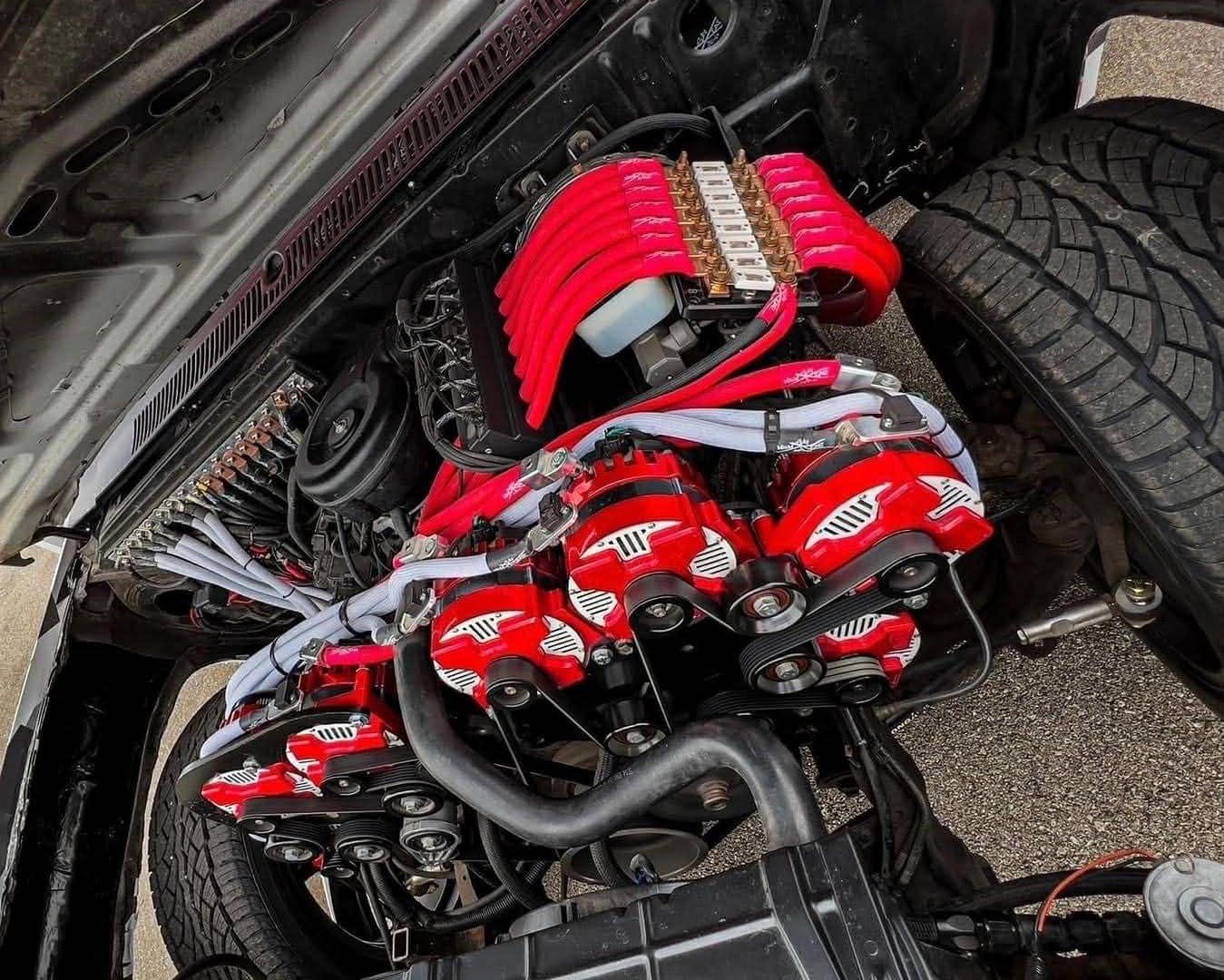
Mechman and Brand X Electrical high-output alternators
-
GP Car Audio power and ground wire
-
Complete Big 3 wiring upgrade kits
-
AGM and lithium batteries from XS Power, Limitless Lithium, and Advanced Electric
-
Amped Up Car Audio 1/0 wiring lugs and heat shrink
Quick Answer: How Much Electrical Do I Need for Car Audio?
To determine how much electrical your car audio system needs, you must account for three key factors:
-
Your total amplifier RMS power
-
Your system’s real operating voltage (not the advertised rating)
-
A safety margin for inefficiency, music dynamics, and impedance rise
Once you know these, electrical upgrades should always be done in this order:
Big 3 wiring → Alternator upgrade → Battery reserve → Power & ground distribution
Step 1: Add Up Your Total RMS Power (Beginner)
Always calculate electrical requirements using RMS power, not peak or max ratings.
Example System:
-
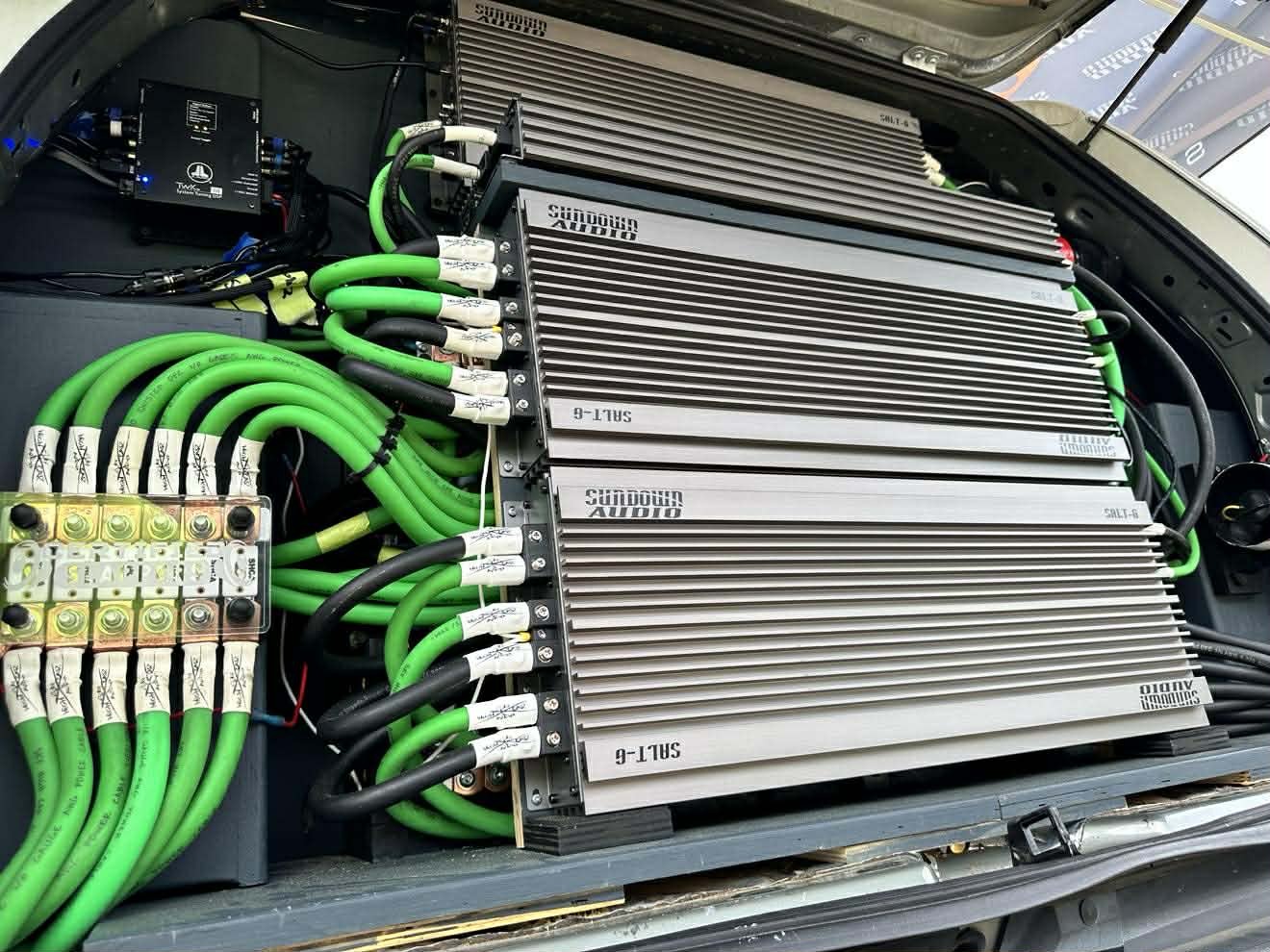
Sundown Audio SALT-2 – 2000W RMS @ 1 ohm
-
Sundown Audio SALT-200.4 – 200W × 4 channels = 800W RMS
Total System Power:
2800 watts RMS
This total RMS number is what you’ll use to estimate current draw and determine how much electrical support your system requires.
Step 2: Convert RMS Watts to Amps (Beginner → Intermediate)
Most people skip this step and guess; this is where problems start.
Formula:
Amps = Watts ÷ Voltage
If your vehicle charges between 14.0V–14.4V, a 2800W RMS system looks like:
This is a best-case estimate before real-world losses are applied.
Step 3: The Three Factors That Change Everything (Intermediate)
Even if an amplifier is rated “2000W at 14.4V,” real vehicles rarely operate under ideal conditions. You must account for:
1) Voltage Drop
If your system drops to 12.8V, your amplifier cannot make rated power and will pull more current, stressing the electrical system.
2) Amplifier Efficiency
-
Most Class A/B operate at 55–70% efficiency
-
High-end designs like Class D may be higher, from 80–90% but none are perfect
This means current draw is always higher than the math suggests.
3) Impedance Rise (Reactive Load)
Subwoofers do not maintain a fixed impedance. As the voice coil moves, impedance changes constantly.
This cannot be calculated precisely, so professionals rely on headroom instead.
Rule of thumb: Add 30–50% safety margin for a stable, reliable electrical system.
Step 4: Real-World Electrical Rules of Thumb (Intermediate)
Alternator Output Rule:
100 amps of alternator output ≈ 1000 watts RMS (ideal conditions)
Most standard alternators are 55-60% efficient and most high output alternators are 80%+
For a 2800W RMS system, you’re realistically looking at:
~280 amps of alternator capability once headroom is added.
Idle Output Reality:
A “150A” alternator may only produce 90–110 amps at idle.
That’s why systems:
-
Die at stoplights
-
Dim lights at idle
-
Recover while cruising
If you play loud at idle, you need:
-
Strong idle-output alternator
-
Adequate battery reserve
-
Proper wiring upgrades
Step 5: How Much Alternator Do I Need for Car Audio? (Step-by-Step)
This is one of the most searched questions in car audio.
Best Method: Clamp Meter Test
-
Fully charge the battery
-
Warm the vehicle up
-
Place a DC clamp meter on the positive battery cable
-
Turn on all accessories and play music loudly
-
Record the peak current draw
Then apply headroom:
Example:
-
Measured draw: 100A
-
Minimum alternator target: 130–150A
For audio systems, bigger is usually better.
Step 6: When Do You Need a High-Output Alternator?
You should strongly consider a HO alternator if:
-
Your system exceeds ~1000W RMS
-
You experience voltage drop or dimming lights
-
Your amplifier enters protect mode
Important Warning
Avoid cheap “high-output” alternators from Amazon or eBay. Many are:
-
Cold-rated only
-
Weak at idle
-
Not designed for sustained audio loads
At Amped Up Car Audio, we trust:
-
Mechman High Output Alternators
-
Brand X Electrical Alternators
These are built for real-world car audio abuse.
Step 7: Do I Need a Big 3 Wiring Upgrade? (Yes.)
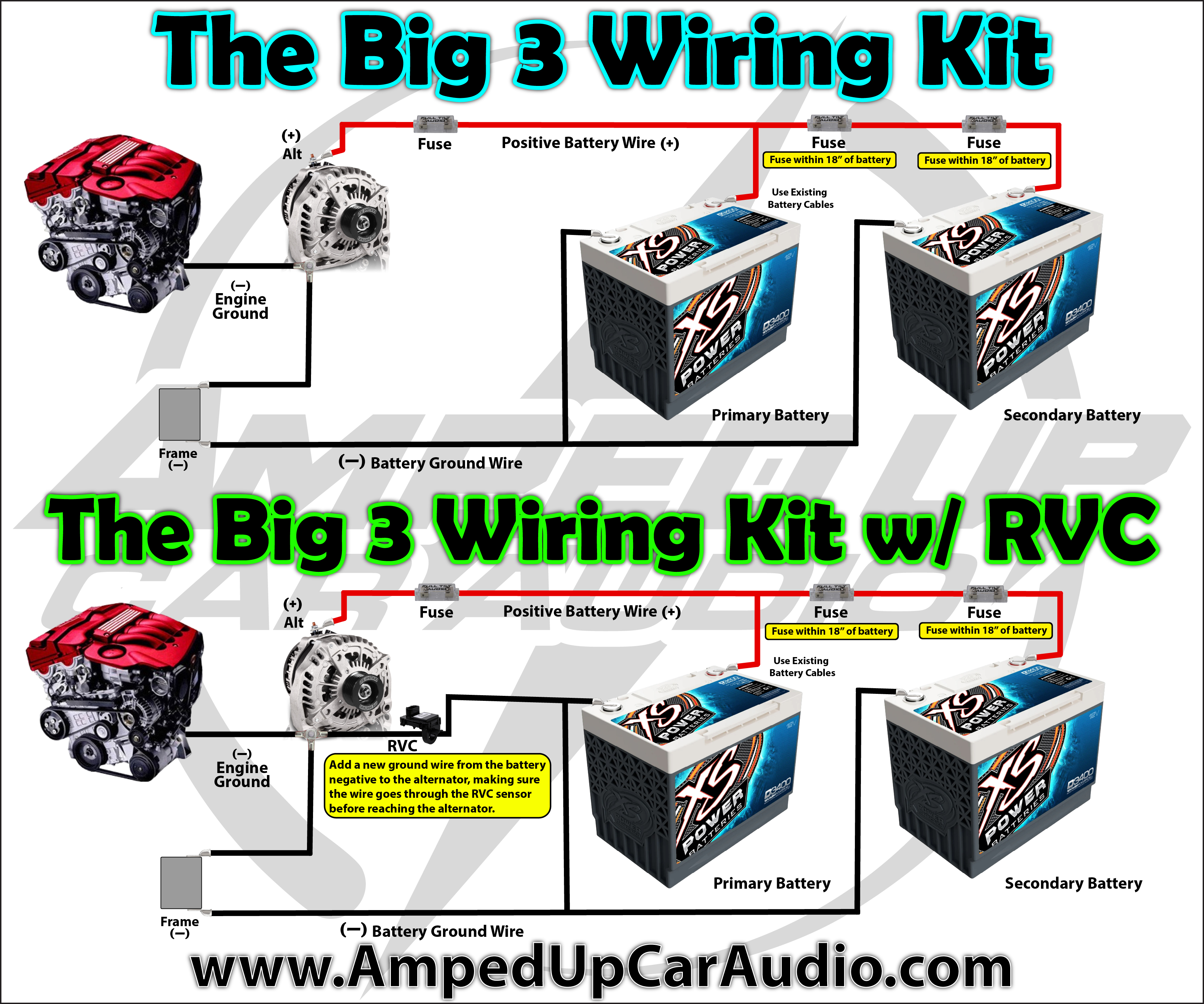
A Big 3 wiring upgrade is required for:
-
High-output alternators
-
High-current audio systems
-
Voltage stability
Big 3 upgrades include:
-
Alternator positive → Battery positive
-
Battery negative → Chassis
-
Engine block → Chassis
Benefits:
-
Reduced resistance
-
Improved charging efficiency
-
Lower heat
-
Stable voltage at the amplifier
To help you do this correctly, we’ve created a detailed guide on our site:
The Big 3 Upgrade: How to Fix Voltage Drop, Stop Lights Dimming, and Improve Car Audio Performance — a step-by-step blog that walks you through the process from start to finish, covering proper wire sizing, installation tips, and common mistakes to avoid.
We also carry complete Big 3 upgrade kits made with high-quality wire, including GP Car Audio, to ensure reliability, durability, and maximum current flow.
Upgrading your wiring is one of the most important steps you can take to protect your electrical system and get the most out of your audio setup.
Step 8: Battery Upgrades – AGM vs Lithium (Intermediate → Advanced)
Upgrade Your Battery If:
-
System exceeds 750–1000W RMS
-
Lights dim on bass hits
-
Voltage drops sharply
-
Starts become weak
AGM vs Lead Acid
-
Lead acid rests at ~12.6V
-
AGM rests at ~12.85V
Mixing them can cause long-term issues. Replacing the stock battery is often best.
We recommend XS Power AGM batteries for many daily builds.
Lithium & Sodium-Ion Batteries (High-End Builds)
Best for:
-
Large systems (3kW+)
-
Stable voltage demands
-
High discharge capability
We carry:
-
Limitless Lithium
-
Advanced Electric
-
XS Power Lithium
Step 9: Beginner to Expert Electrical Targets (Cheat Sheet)
Under 1000W RMS
-
Stock alternator usually OK
-
Big 3 recommended
-
AGM upgrade helpful
1000–3000W RMS
-
Big 3 required
-
HO alternator recommended
-
AGM or entry lithium
3000–6000W RMS
-
HO alternator required
-
Big 3 + 1/0 wiring required
-
Lithium or sodium-ion recommended
6000W+
-
Large or multiple HO alternators
-
Proper fusing & distribution
-
Lithium battery bank
Step 10: The #1 Test to Know If Your Electrical Is Enough
Use a voltmeter at the battery or amplifier input.
With the engine running and music playing:
-
Ideal voltage: 13.8V–14.6V
-
Below 12.6V: Electrical system is undersized
Final Word from Amped Up Car Audio
Electrical is the difference between:
-
A system that plays loud and clean every day
-
And a system that clips, dims, and destroys equipment
If you want help sizing your alternator, wiring, and battery setup for your exact system, email us anytime:
Written by Jacob Morris
Electrical Specialist & Co-Owner
Amped Up Car Audio