
The Best Car Audio Battery: Power Up Your Sound System Effectively
Posted by Jacob Morris on Jan 24th 2026
Car Audio Battery Upgrade Guide
When Should You Upgrade Your Car Audio Battery? (Step-by-Step Guide)
Upgrading your car audio system often leads to one critical question: how much battery do I actually need to support my amplifiers and subwoofers?
This guide is for car audio enthusiasts, DIY installers, and anyone considering a battery upgrade for their vehicle’s sound system. Choosing the right battery is crucial to prevent system failures, protect your equipment, and achieve the best sound quality.
Choosing the wrong battery setup can result in voltage drops, headlights dimming on every bass hit, amplifiers clipping or going into protect mode, and even damaged electrical components. This guide breaks everything down in a clear, step-by-step way so you can confidently choose the right car audio battery upgrade for your system.
We’ll cover how to calculate your actual battery needs, how your alternator factors into the equation, the real differences between AGM, lithium, and sodium-ion batteries, and when brands like XS Power, Limitless Lithium, and Advanced Electric make sense for your build, including whether lithium technology makes sense for your specific car audio setup.
Quick Answer: Do YOU Need a Car Audio Battery Upgrade?
If you’re running a car audio system over approximately 1000W RMS, experiencing dimming lights when bass hits, or noticing your amplifiers going into protect mode during loud playback, you likely need an upgraded battery system. Most daily drivers with factory alternators simply cannot keep up with the current demands of modern high-power Class D amplifiers.
Common Questions About Car Audio Battery Upgrades
When considering a car audio battery upgrade, many enthusiasts have similar questions. Here are answers to some of the most frequently asked:
Do I really need a battery upgrade?
If your system causes headlights to dim during bass hits, has more than approximately 1000W RMS power, or you often play music with the engine off, an upgrade is necessary. This ensures stable voltage, protects your amplifiers and other equipment, and prevents premature alternator wear.
AGM vs. Lithium: Which is better?
AGM batteries are an excellent choice for daily drivers with moderate power needs, typically up to 1500W–2000W RMS. They are reliable, maintenance-free, and compatible with factory charging systems. Lithium batteries—such as LiFePO₄ or LTO chemistries—are preferred for high-power systems exceeding 3000W RMS. They offer faster charging, significantly lighter weight, and more stable voltage under heavy load, which translates to improved sound quality and system reliability.
Should I add a second battery?
Yes. When your system’s total power draw surpasses your alternator’s capacity, adding a secondary battery—especially mounted near the amplifiers in the trunk or rear of the vehicle—provides immediate amperage during bass hits. This reduces voltage sag and helps maintain consistent power delivery.
Can I mix different battery types (e.g., AGM + Lithium)?
It is generally not recommended to mix different battery chemistries within the same system. Different resting voltages and charging profiles can cause imbalance, leading to inefficient charging, faster battery wear, and potential premature failure. For best results, use batteries of the same type, brand, and age in your setup.
Signs you need a car audio battery upgrade:
-
Headlights or interior lights dim noticeably when bass hits hard
-
Amplifier goes into protect mode or shuts off during loud music
-
Voltage drops below 12.6V at the battery when playing at volume
-
Your stock alternator feels constantly overworked or runs hot
-
You’ve added more than 1000W RMS of amplifier power to your vehicle
Most daily systems running above 1000–1500W RMS in 2025—especially with today’s efficient but power-hungry Class D amplifiers—should plan for at least one upgraded AGM or lithium battery, particularly when paired with a factory alternator rated under 200A.
At Amped Up Car Audio (online only), we specialize in matching real-world systems to the correct XS Power, Limitless Lithium, and Advanced Electric batteries based on your actual power requirements, vehicle, and listening habits.
The rest of this article will walk you step-by-step through calculating your power needs, understanding alternator limits, and selecting the right battery chemistry for your build.
Why Battery Capacity Matters in Car Audio
Your vehicle’s electrical system works like a simple partnership: the alternator generates power while the engine runs, and your battery stores energy to support sudden demands. When your subwoofers hit hard and your amplifiers demand current faster than the alternator can supply it, your battery steps in to fill that gap.
What happens when your battery system is undersized:
-
Voltage drops measurably below 12.6V during bass-heavy tracks, starving your amplifiers of the power they need
-
Headlights and interior lights visibly dim with every kick drum and bass note
-
Amplifiers clip, distort, or shut down entirely as voltage sags below their operating threshold
-
Your alternator runs at or near maximum output constantly, leading to premature wear and potential failure
-
The vehicle’s ECU and other factory electronics can behave erratically due to unstable voltage
Modern Class D subwoofer amplifiers—even “modest” units rated at 1500–3000W RMS—can demand bursts of 150–300+ amps during heavy bass passages. Stock alternators in most cars and trucks are rated between 130–220A, but they’re already busy powering your AC, heated seats, headlights, fuel pump, and factory electronics. That leaves far less current available for your audio system than most people realize.
A properly sized battery bank does more than prevent dimming lights. It improves sound quality by delivering tighter, more controlled bass with less distortion. It protects your expensive subwoofers and amplifiers from damage caused by voltage sag. And it keeps your vehicle’s electrical system stable and healthy for the long term.
Step 1: Calculate Your Total Amplifier RMS Power
Every car audio electrical calculation starts with knowing your true RMS power—not the inflated “max” or “peak” numbers printed on amplifier boxes and online listings. RMS (Root Mean Square) is a measure of continuous power output, representing the real-world power your amplifier can deliver. RMS represents the continuous power your amplifiers actually deliver, and it’s the only number that matters for electrical planning.
For a deeper understanding of RMS versus peak power and how they affect your car audio system, check out our blog titled "Peak vs RMS Power in Car Audio: What's the Real Difference?" which explains these concepts in detail.
To find your total system power, add up the RMS wattage of every amplifier in your vehicle.
Example calculation:
Let’s say you’re building a system in a 2020 Honda Civic. You’ve installed a monoblock subwoofer amplifier rated at 1500W RMS powering your subs, plus a 4-channel amplifier rated at 500W RMS handling your mids and highs. Your total system power is 1500W + 500W = 2000W RMS.
-
Always use RMS ratings from the amplifier manual or verified manufacturer specifications
-
Check ratings at realistic system voltage (12–14.4V), not inflated numbers at 16V or higher
-
Reference trusted brands like Sundown Audio, Rockford Fosgate, JL Audio, or Kicker for accurate specs
-
Remember that clipping your amplifiers (running gain too high) effectively increases current draw and electrical stress beyond the rated RMS, so proper tuning matters
This total RMS figure becomes the foundation for every calculation that follows.
Step 2: Convert Watts to Current (Amps)
Once you know your total RMS wattage, you need to convert that to current draw so you can understand the actual load on your electrical system.
The core formula is simple:
Current (Amps) = Total RMS Watts ÷ System Voltage
Most vehicle electrical systems operate between 12–14V depending on whether the engine is running and the alternator is charging.
Continuing our 2000W RMS example:
At 12V (a conservative estimate representing voltage under load): 2000W ÷ 12V = approximately 167 amps
This means your amplifiers can draw around 167A of current during demanding playback.
-
Many high-output Class D amplifiers are 80–90% efficient, meaning actual current draw can be 10–20% higher than the simple calculation suggests
-
Systems wired at 1 ohm or below tend to draw current at the upper end of estimates
-
Bass-heavy music played at high volume sustains peak current draw longer than mixed genres
-
Always calculate using the lower voltage figure (12V) to account for worst-case scenarios
Step 3: Add Headroom for Real Music Use
The simple wattage-to-amps calculation gives you a baseline, but real-world music playback isn’t perfectly consistent. Your system experiences peaks, transients, and sustained bass passages that can exceed average current draw. That’s why experienced installers and competition builders add a 30% buffer to their calculations.
Applying headroom to our example:
If your initial current draw calculation shows 167A, multiply by 1.3 to account for headroom: 167A × 1.3 = approximately 217 amps
This 217A figure represents your realistic current demand during loud, bass-heavy playback.
This headroom accounts for amplifier inefficiency losses, voltage sag under load, gain overlap between multiple amplifiers, and the dynamic peaks in bass-heavy tracks that momentarily spike current demand. Skipping this step is exactly why so many people think “my math said it would be fine, but my lights still dim.”
Step 4: Understand Your Alternator’s Real Output
Most modern daily drivers from 2015–2024—whether sedans, trucks, or SUVs—come with alternators rated somewhere between 130–220A. But that rating represents maximum output at specific RPM under ideal conditions, and critically, not all of that capacity is available for your audio system.
What your alternator is already doing:
-
Approximately 60–70% of your alternator’s rated output is consumed by factory vehicle loads including the ECU, fuel pump, electric power steering, HVAC blower, headlights, rear defroster, and various sensors and modules
-
A typical 150A alternator may only have 50–60A of “extra” capacity available for aftermarket accessories like car audio
-
Larger trucks and SUVs with more electronics often have less spare capacity despite higher-rated alternators
The 50A per 500W rule of thumb: For optimal performance when applying this rule, consider pairing your system with high-quality subwoofers from Amped Up Car Audio.
About 50 amps of available alternator output can safely support approximately 500W RMS of continuous music playback, assuming a healthy battery and proper wiring.
Real-world example:
Consider a 2018 Ford F-150 with a 200A factory alternator. Between running lights, climate control, the touchscreen infotainment, various pumps and modules, and powering the truck’s electronics, roughly 130–140A is already spoken for. That leaves only about 60–70A available for an aftermarket audio system—enough to continuously support maybe 600–700W RMS before you start dipping into battery reserve.
Systems over approximately 1000W RMS running on a stock alternator are already relying heavily on battery reserve during loud playback. Once you reach 2500–6000W RMS territory, upgrading to a high-output alternator plus upgraded batteries becomes strongly recommended—not optional.
Step 5: How Much Battery Do You Actually Need?
After calculating your power requirements and understanding your alternator’s real capacity, you can determine how much battery reserve your system needs.
The baseline rule of thumb:
Every 100Ah of quality battery capacity can comfortably support approximately 1200W RMS of car audio power in real-world use.
Every 10 amp hours (Ah) of lithium battery capacity can support roughly 1,000 watts RMS of amplifier power. This is not an exact formula, but rather a practical guideline that helps builders estimate how much battery capacity they need for a given system. The actual wattage a lithium battery can support depends on several key factors, including the type of lithium chemistry, discharge rate, internal resistance, and overall electrical system efficiency.
Applying this to a real system:
A 2400W RMS system could use roughly 200Ah total of high-quality AGM or lithium/sodium-ion capacity, assuming a reasonable alternator upgrade (200–300A) and proper wiring throughout.
Battery voltage differences matter more than you might think:
-
Standard lead-acid batteries rest around 12.6V
-
AGM batteries rest slightly higher at approximately 12.8–12.9V
-
Lithium and sodium-ion systems typically hold a higher and more stable voltage under load, often maintaining 13.0–14.8V depending on chemistry and charge profile
Higher and more stable voltage directly affects amplifier performance. Your amps produce more power and clip less at the same volume setting when fed clean, stable voltage. This translates to better sound quality, tighter bass response, and significantly reduced headlight dimming.
The “100Ah ≈ 1200W RMS” guideline is a starting point for most daily driver builds. Competition vehicles and demo trucks often exceed this ratio with more aggressive alternator setups and optimized charge profiles to maximize performance during short bursts of extreme output.
AGM vs Lithium vs Sodium-Ion: Which Car Audio Battery Is Right for You?
At Amped Up Car Audio, we frequently match customers to the right battery chemistry based on their power level, vehicle, intended use, and subwoofer box design. The three main options—AGM, lithium, and sodium-ion—each serve different applications best.
AGM (Absorbent Glass Mat) is a type of sealed lead-acid battery known for its maintenance-free design, vibration resistance, and ability to deliver high burst current. AGM batteries remain the go-to choice for daily drivers and moderate systems up to roughly 3000W RMS. They’re proven, affordable relative to lithium, and work seamlessly with factory charging systems.
Lithium batteries (including LiFePO4 (Lithium Iron Phosphate), a lithium battery chemistry prized for its safety and stability, and LTO (Lithium Titanate Oxide), a lithium chemistry known for rapid charging and long lifespan) excel in heavy daily use and competition builds where weight savings, high discharge rates, and stable voltage under extreme loads are priorities. When comparing lithium chemistries, things like safety, temperature handling, and practical advantages such as reduced size and weight set options like LiFePO4 apart from traditional AGM batteries. LiFePO4 is especially valued for its stability and safety, while LTO offers superior low-temperature performance.
Sodium-ion batteries represent the cutting edge for extreme car audio systems, offering exceptional safety, rapid charging, and massive power delivery for builds ranging from 6000W to over 30,000W RMS. Sodium-ion is a newer battery chemistry that uses sodium ions for charge storage, providing high discharge rates and excellent safety.
The following sections break down each chemistry with specific brand recommendations you can shop at Amped Up Car Audio.
AGM Car Audio Batteries (XS Power D-Series, XP-Series, and More)
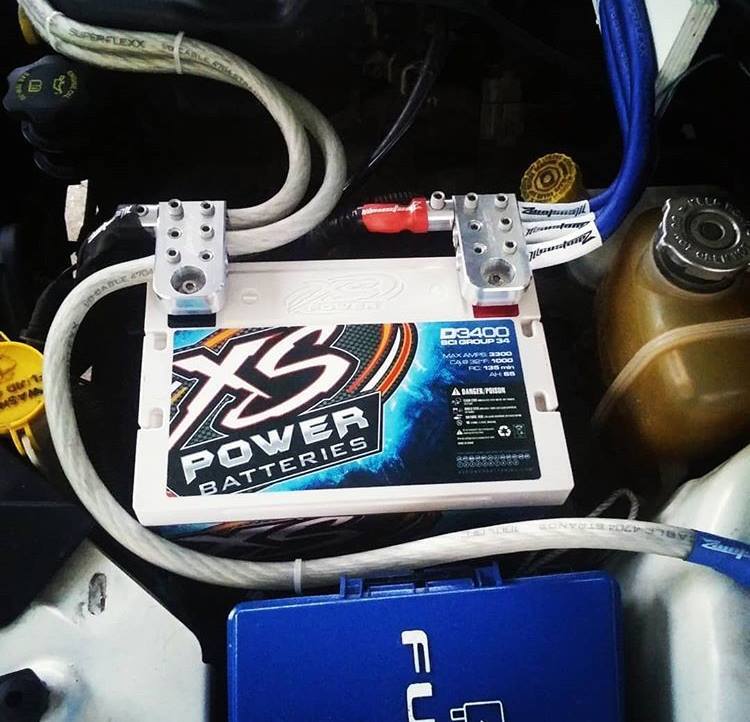
AGM (Absorbent Glass Mat) batteries are sealed lead-acid designs that use fiberglass mats to hold the electrolyte, eliminating the spilling and maintenance issues of traditional flooded batteries. They offer lower internal resistance, faster discharge capability, and excellent vibration resistance—all critical for handling the punishment of powerful bass.
XS Power is the go-to AGM brand for car audio at Amped Up Car Audio. Their flagship D-Series line (available in 12V, 14V, and 16V configurations) is specifically engineered for daily drivers and high-performance audio builds.
D-Series highlights:
-
Built with 99.99% pure lead for maximum conductivity and durability
-
Thin plate design creates massive surface area for high burst current delivery
-
Direct-fit options available for popular vehicles (D3400 and D4800 for many GM trucks, D6500 for large SUVs, etc.)
-
Sealed, maintenance-free, and can be mounted in virtually any position
Other XS Power series worth knowing:
|
Series |
Best For |
Key Features |
|---|---|---|
|
Auxiliary/secondary batteries |
Ideal for trunk-mounted reserve near amplifiers |
|
|
Racing applications |
Low weight, high cranking amps |
|
|
Powersports (motorcycles, ATVs, UTVs) |
Compact, vibration-resistant |
|
|
Classic vehicles |
12V with vintage-compatible fitment |
Pros of AGM for car audio:
-
Easy drop-in replacement compatible with factory charging systems
-
Proven reliability for systems up to roughly 1500–3000W RMS (depending on alternator and number of batteries)
-
Significantly more affordable than lithium or sodium-ion options
-
No special charging requirements or compatibility concerns
Cons of AGM:
-
Heavier than lithium alternatives (often 50–70 lbs for high-capacity models)
-
Lower energy density means larger physical size for equivalent capacity
-
Usable capacity drops at very high discharge rates compared to lithium or sodium-ion
Important note: Never mix a standard flooded lead-acid battery with AGM in the same system. The different chemistries have incompatible charging profiles, leading to uneven charging, slow drain, and premature battery wear. If upgrading from a stock lead-acid starting battery, remove it entirely and replace with AGM.
Lithium Car Audio Batteries (XS Power Titan8 & xMax)
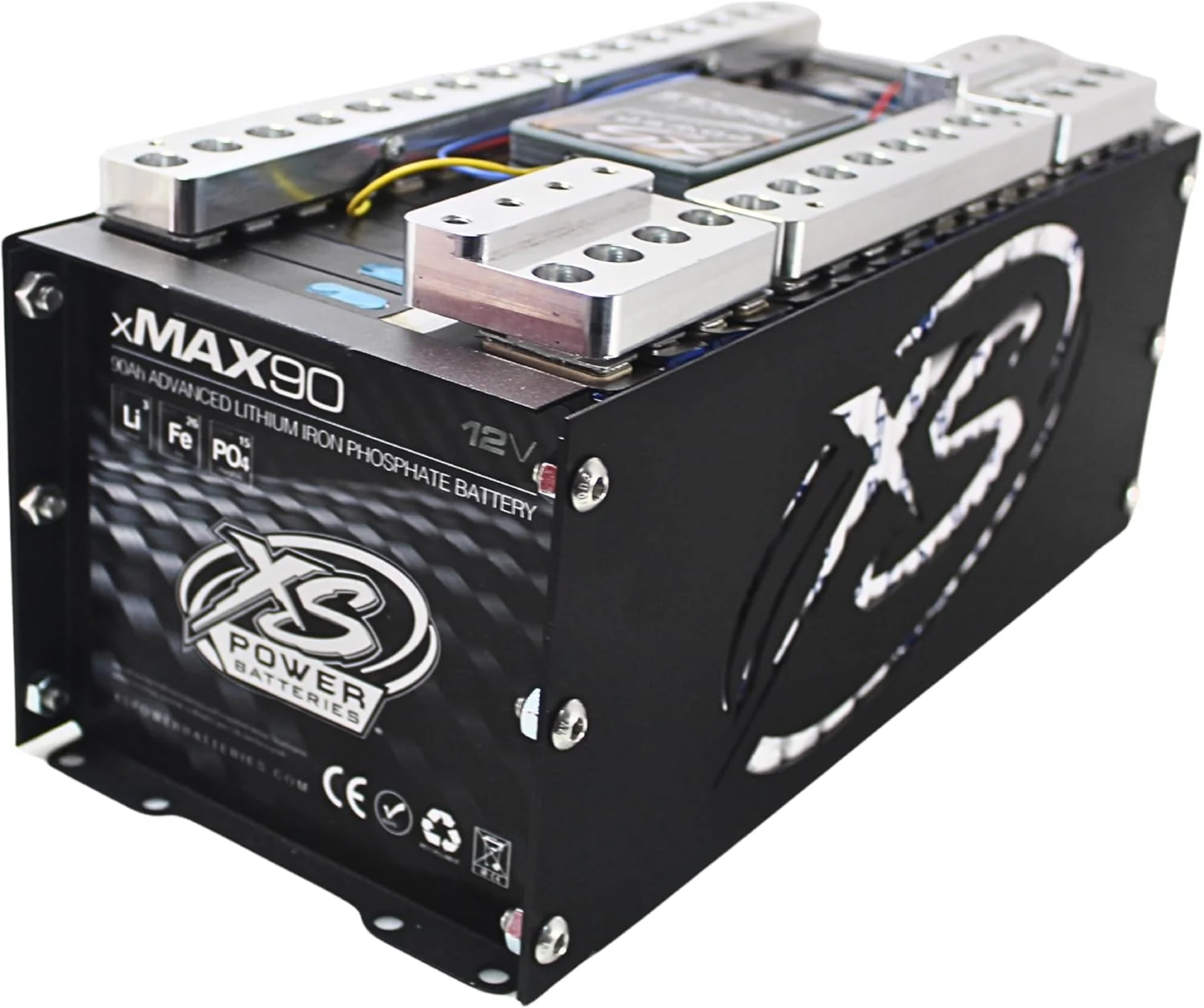
Lithium batteries used in car audio applications are typically either LiFePO4 (Lithium Iron Phosphate) or LTO (Lithium Titanate Oxide). LiFePO4 is a lithium battery chemistry prized for its safety, stability, and long cycle life. LTO is a lithium chemistry known for extremely fast charging, high power output, and exceptional lifespan. Both chemistries are significantly safer and more thermally stable than the older lithium-ion cells found in consumer electronics, making them suitable for the demanding underhood environment.
XS Power Titan8 is a high-performance LTO series available in 12V, 14V, and 16V configurations. LTO chemistry offers some of the most impressive specifications in the industry:
-
1,000+ amps of burst power for extreme current demands
-
3–5x faster charging than standard lithium chemistries
-
Potential 20–25 year lifespan under proper operating conditions
-
Titanium alloy cases for enhanced safety and durability
-
Built-in cell balancing for long-term health
Some advanced lithium batteries also offer Bluetooth connectivity, allowing users to monitor and control battery status via a dedicated app on their smartphone or tablet.
XS Power Titan8 Direct Fit Batteries: Under-Hood High-Performance Lithium Solutions
XS Power Titan8 Direct Fit batteries are high-performance Lithium Titanate Oxide (LTO) batteries engineered specifically for plug-and-play, under-hood replacement applications across a wide range of vehicles. Designed to fit standard battery locations such as Group 34, these batteries provide an easy upgrade path for enthusiasts seeking to enhance their car audio systems without complicated modifications.
Key features of Titan8 Direct Fit batteries include:
-
Support for up to 10,000 watts RMS in car audio systems, delivering the power needed for demanding amplifiers and subwoofers
-
Significant weight savings compared to traditional AGM batteries, improving overall vehicle performance and handling
-
Rapid recharge capabilities that reduce alternator strain and downtime between heavy usage
-
High burst power output to handle intense bass hits and transient demands with minimal voltage sag
-
Durable construction suitable for under-hood environments, including vibration resistance and thermal stability
By offering a direct replacement for factory batteries, XS Power Titan8 Direct Fit batteries simplify installation while providing the advanced electric performance benefits of lithium technology. Whether upgrading a daily driver or building a competition rig, these batteries deliver reliable, consistent power in a compact, lightweight package.
XS Power xMax LiFePO4 series represents the ultimate in high-output power cells for competition and extreme daily use:
|
Model |
Power Rating |
Best Use Case |
|---|---|---|
|
Up to 14,000W RMS (with 300A alternator) |
Heavy competition, demo vehicles |
|
|
8,000–30,000+W RMS |
SPL builds, extreme installs |
These cells can be connected in parallel to create massive power banks for the most demanding competition applications.
Pros of lithium for car audio:
-
Dramatically lighter weight (often half the weight of equivalent AGM capacity)
-
Higher usable capacity at extreme discharge rates
-
Extremely stable voltage under heavy load (less sag, more consistent amp performance)
-
Very fast recharge times reduce strain on the alternator
Cons of lithium:
-
Higher upfront cost (typically 2–3x AGM for equivalent capacity)
-
More sensitivity to improper charging—must ensure alternator and voltage settings are appropriate
-
14V and 16V setups require careful system configuration
Real-world application example: A 10,000W RMS competition build might run multiple XS Power xMax cells in parallel, paired with a 300–400A high-output alternator and lithium-compatible charging profile. This setup delivers massive instantaneous current while keeping voltage rock-solid during bass sweeps.
Sodium-Ion Car Audio Batteries (Limitless NoLi & Advanced Electric KILO)
Sodium-ion is a newer battery chemistry that uses sodium ions for charge storage, providing high discharge rates and excellent safety. Sodium-ion (Na-ion) technology represents an emerging option in high-power car audio, offering exceptional discharge rates, a strong safety profile, and excellent voltage retention—particularly attractive for 12–16V high-output systems.
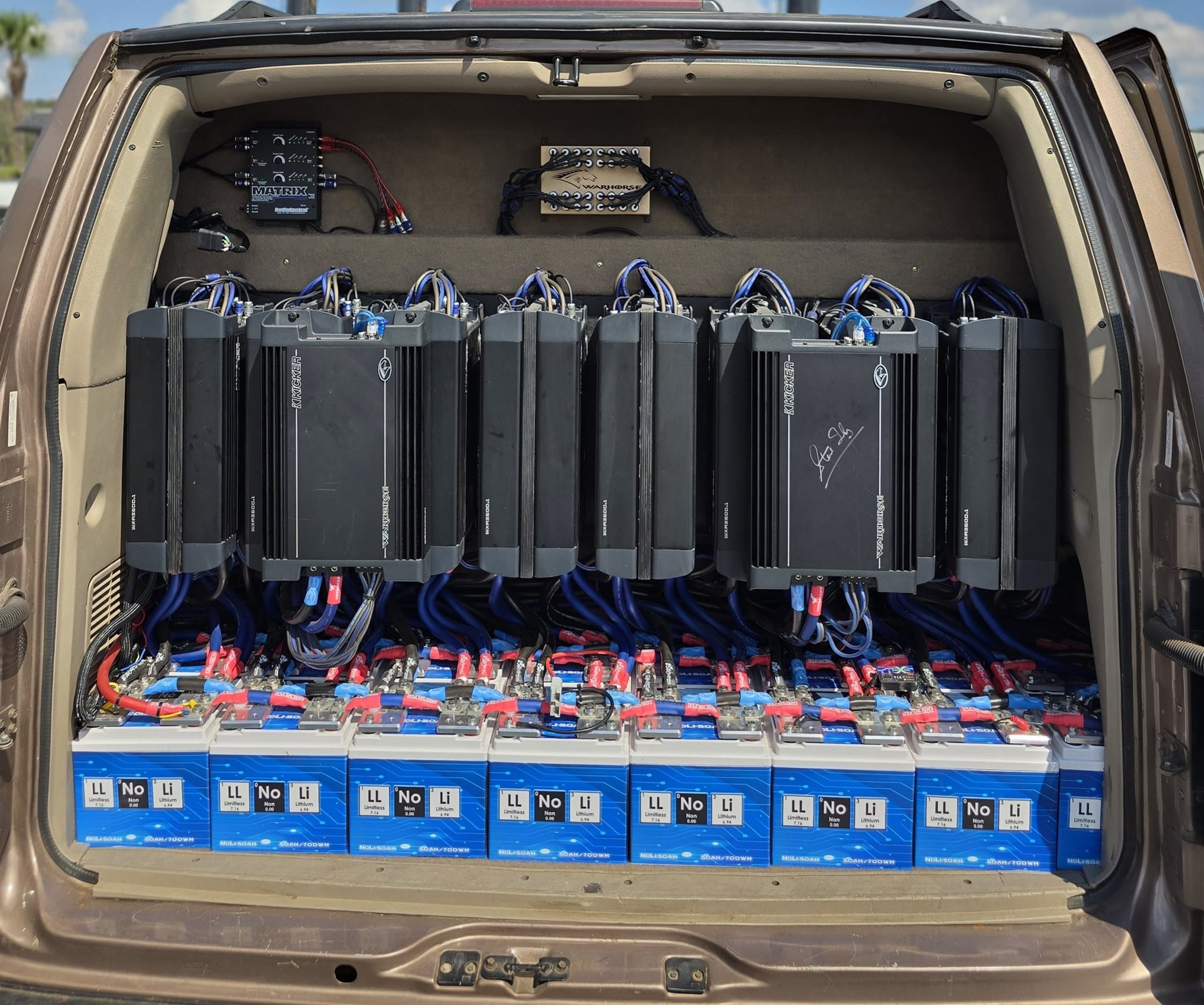
Limitless Lithium NoLi series sodium-ion power cells are purpose-built for demanding applications like car audio, marine, and off-grid power systems:
|
Model |
Capacity |
Power Support |
Notes |
|---|---|---|---|
|
12Ah |
Up to ~6,000W RMS |
Entry-level sodium-ion |
|
|
30Ah |
6,000–8,000W RMS |
Sweet spot for serious daily builds (with 100A alternator at 16V) |
|
|
50Ah |
Up to ~13,000W RMS |
Multi-battery configurations |
Key NoLi features:
-
Resting voltage range of 12–15.5V with capability up to 16V for maximum performance
-
Superior voltage retention under heavy load compared to lead-acid chemistries
-
Fast discharge rates for instant current delivery during bass hits
Limitless Nano-HD series offers waterproof lithium (LiFePO4) options specifically for motorcycles, UTVs, and powersports vehicles with big audio systems:
-
IP-certified waterproof construction
-
Built-in BMS (Battery Management System) for safety and cell protection
-
Support for 5,500–6,000W in compact packages
-
Nano-HD V3 designed specifically for Harley-Davidson and similar motorcycles
Advanced Electric KILO and KILO HP series are purpose-built sodium-ion batteries engineered specifically for extreme car audio:
|
Model Range |
Capacity |
Power Support |
Features |
|---|---|---|---|
|
37–110Ah |
8,900W–12,000W+ RMS |
Standard KILO line |
|
|
40Ah |
~8,900W RMS |
High Performance series |
|
|
80Ah |
~15,000W RMS |
Active balancing |
|
|
200Ah |
33,000W+ RMS |
Extreme competition |
Advanced Electric KILO HP batteries feature active balancing technology and support for mixed-chemistry setups when properly configured, making them versatile options for complex competition builds.
Sodium-ion systems from both Limitless and Advanced Electric are best suited for serious daily demo vehicles and competition builds where high wattage, safety, and fast recharge capability are critical requirements. Both the KILO, KILO HP, and NoLi series can be used alongside any type of lithium battery, making them incredibly versatile and flexible for a wide range of applications.
Step 6: Real-World Electrical System Example (6000W Build)
Let’s walk through a realistic scenario that demonstrates how alternator capacity and battery reserve must work together in a high-power build.
The situation:
A customer comes in with a 2019 Chevrolet Silverado running the factory 130A alternator. They’ve installed a pair of 3000W RMS monoblock amplifiers for a total of 6000W RMS—serious bass power. The factory starting battery is still in place.
Calculating available alternator support:
That 130A alternator, with the truck’s lights, climate control, infotainment, and various modules running, realistically has about 50A available for audio. Using our 50A ≈ 500W rule, that’s only about 500–600W RMS of continuous charging support—a tiny fraction of what 6000W demands.
What this means in practice:
When playing bass-heavy music at volume, this system is drawing roughly 650–750A of peak current (6000W ÷ 12V × 1.3 headroom). The alternator can only supply a small fraction of that, meaning the batteries are providing the overwhelming majority of the current. Voltage will crash rapidly, the alternator will run at maximum output constantly, and the system will experience dimming, clipping, and potential shutdowns.
The recommended solution path:
-
Upgrade the alternator to a 250–300A high-output unit (brands like Mechman or Brand X make excellent options)
-
Replace the starting battery with an XS Power D-Series AGM, SuperBank, or Titan8 LTO Direct Fit for improved current delivery and compatibility. Alternatively, you can use a battery delete kit to remove the factory battery and relocate all your batteries to the rear of the vehicle. This setup helps optimize space and improve weight distribution. The XS Power SuperBank can be used in the stock battery location and is designed to be compatible with any lithium battery chemistry, offering flexibility for your build. However, it’s very important not to mix different lithium chemistries within the same system to maintain safety, ensure proper battery management, and achieve the best performance.
-
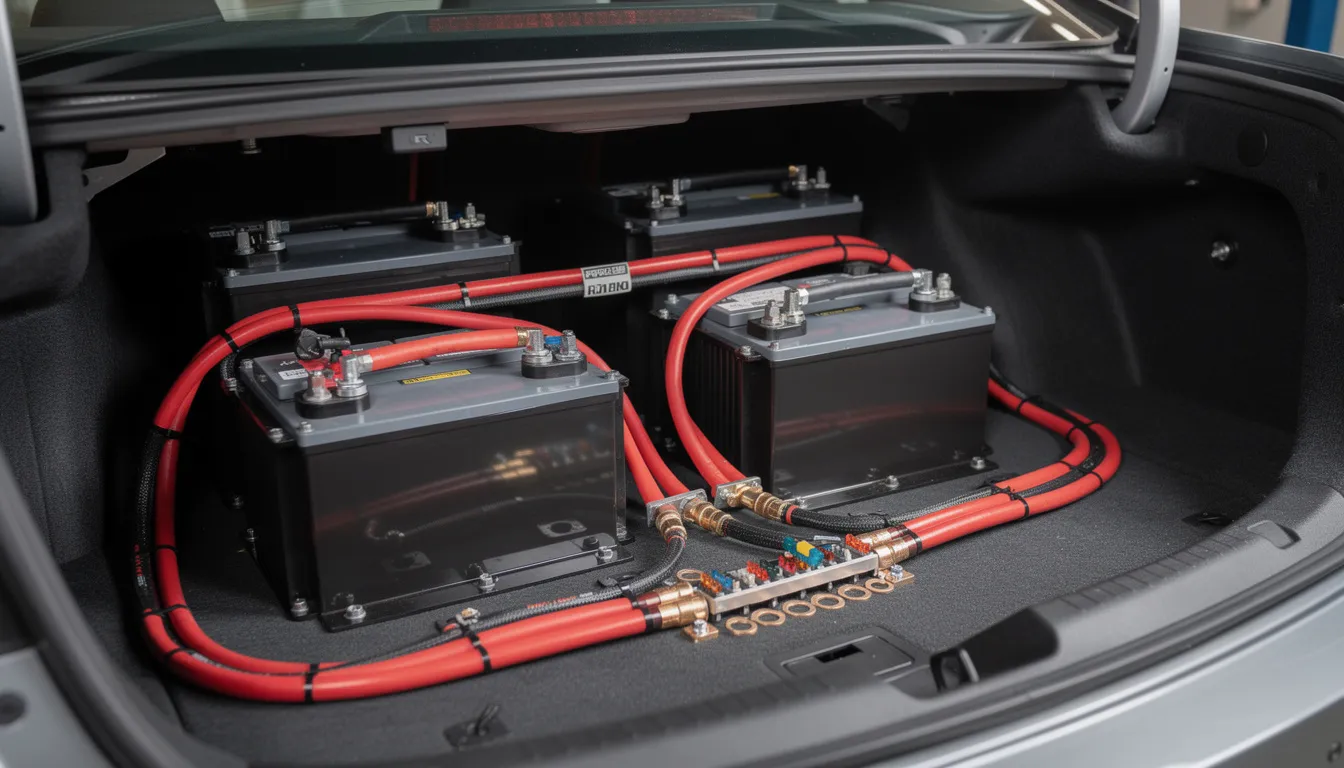
Add secondary batteries near the amplifiers—one or more XS Power xMax cells, Limitless NoLi 30Ah or 50Ah packs, or Advanced Electric KILO HP series units mounted in the bed or trunk
-
Complete a Big 3 upgrade with appropriate gauge OFC (oxygen-free copper) cable runs. A Big 3 upgrade refers to upgrading the three main power and ground wires in your vehicle’s electrical system to larger gauge cables for improved current flow.
-
Run dedicated power and ground cables to the rear battery bank with proper fusing
This balance between upgraded alternator output (charging) and expanded battery capacity (storage) is what allows high-power systems to perform reliably without destroying the electrical system.
For those interested in upgrading their wiring, we also offer a detailed step-by-step guide called Essential Guide to the Big 3 Kit: Boost Your Car's Performance to help you successfully complete the Big 3 upgrade and maximize your vehicle’s electrical performance.
This balance between upgraded alternator output (charging) and expanded battery capacity (storage) is what allows high-power systems to perform reliably without destroying the electrical system.
Step 7: Testing Your Voltage the Right Way
After installing or upgrading your car audio battery system, voltage testing under load is the only way to confirm your setup is truly healthy and properly sized.
How to test properly:
-
Use a quality digital voltmeter or multimeter
-
Measure voltage at the main battery terminals AND at the amplifier power inputs
-
Test with the engine running, headlights on, and music playing loudly (this simulates real-world use)
-
Play bass-heavy tracks at your typical listening volume for at least 30–60 seconds
-
Note the lowest voltage reading during sustained bass passages
Target voltage ranges:
|
Voltage Reading |
Status |
|---|---|
|
13.8–14.5V |
Ideal—system is healthy and well-balanced |
|
13.0–13.7V |
Acceptable for most systems, monitor for trends |
|
12.6–12.9V |
Marginal—battery providing more support than ideal |
|
Below 12.6V |
Upgrade needed—insufficient alternator, battery, or both |
Rapid voltage dips into the low 12s or 11s during bass hits indicate your electrical system cannot keep up. This causes amplifier clipping, protect mode activation, and long-term damage to both electrical components and audio equipment.
Many serious enthusiasts install a dash-mounted digital voltmeter for real-time monitoring. Some competition builders log voltage and current during tuning sessions to identify exactly when and where their system needs more capacity.
Installation and Safety: Doing It Right and Staying Protected
Installing a high-performance car audio battery—whether it’s an XS Power AGM, a cutting-edge Advanced Electric sodium-ion, or a marine-grade lithium solution—demands careful attention to both safety and quality. The right installation not only enhances your car audio system’s power and reliability, but also protects your investment and ensures long-term performance across different applications, from cars and RVs to marine and boating setups.
Choosing the Right Location
Start with the right location: Before you connect anything, select a spot that offers enough space, easy access, and secure mounting. In cars, the trunk or under the hood are common choices, but for RVs and marine applications, you’ll want a location that’s protected from moisture and vibration. Always account for the battery’s weight and make sure it’s firmly fastened—this prevents movement that could damage cables or cause dangerous shorts, especially when your vehicle is in motion or your boat is facing rough waters.
Making Proper Connections
Connect with confidence: Use high-quality cables and connectors—XS Power and Advanced Electric both offer options designed to handle more power with minimal loss. Properly crimped and insulated connections are essential to prevent voltage drops, interference, and even fire hazards. For advanced electric systems, integrating a reliable Battery Management System (BMS) is crucial. The BMS monitors and balances your battery cells, protecting against overcharging, deep discharging, and overheating, which is especially important for lithium and sodium-ion batteries.
Selecting the Right Battery
Choose the right battery for your application: AGM batteries are a solid, affordable choice for many cars, but if you need more power, lighter weight, or are working in a marine or RV environment, lithium or sodium-ion batteries may be a better fit. XS Power batteries are known for their quality and performance, while Advanced Electric offers specialized solutions for extreme builds and different applications. Always consider the details—such as price, weight, and compatibility with your system—before you add a battery to your cart.
Getting Expert Help
Get expert help and keep learning: If you’re new to car audio installations, don’t hesitate to search for videos, read detailed guides, or visit a professional shop. Many shops offer installation services and can help you select the best battery for your needs. Online content, including tutorials and public forums like r/CarAV, is a great way to understand the pros and cons of different options, from AGM to lithium to sodium-ion. You’ll find real-world reviews, installation tips, and advice on how to enhance your system safely.
Think beyond audio: Car audio batteries aren’t just for powering amplifiers and subwoofers—they can also support accessories like lifts, winches, and lighting in cars, RVs, and boats. Understanding your system’s total power requirements and choosing a battery that matches those needs will help you avoid issues down the road.
Stay connected and informed: To continue your search for the perfect battery, compare options, and access exclusive offers, consider creating an account with your favorite shop or manufacturer. Many brands, including Advanced Electric, offer additional content, support, and deals to registered users. If you ever forget your password, recovery options are available so you can quickly get back to shopping and learning.
Join the conversation: Public forums and community groups are full of users sharing their experiences with different batteries, installation techniques, and advanced electric solutions. Reading these discussions can help you find the best options for your specific needs and budget.
In summary: A safe, high-quality installation is the foundation of any powerful car audio system. By choosing trusted brands like XS Power and Advanced Electric, using the right components, and following best practices for installation and safety, you’ll create a system that delivers more power, better sound, and long-lasting reliability—no matter where your adventures take you. Continue exploring, compare your options, and don’t hesitate to reach out to experts or the community to ensure your next upgrade is your best yet.
Understanding Ah vs Wh for Car Audio Batteries
When comparing batteries across different chemistries and voltages, amp-hours (Ah) alone doesn’t tell the full story. To make accurate comparisons, you need to understand watt-hours (Wh).
The basic relationship:
Watt-hours (Wh) = Amp-hours (Ah) × Voltage
This formula gives you the total energy storage capacity of a battery, regardless of its chemistry or nominal voltage.
Why this matters for car audio:
Traditional lead-acid and even AGM batteries lose significant usable capacity when discharged at high rates. A 100Ah AGM battery might only deliver 60–70Ah of usable capacity when powering a 3000W system. Lithium and sodium-ion batteries maintain much more of their rated capacity at high discharge rates—often 80–90% of stated Ah.
Practical comparison example:
|
Battery |
Ah Rating |
Nominal Voltage |
Total Wh |
Usable at High Discharge |
|---|---|---|---|---|
|
100Ah AGM |
100Ah |
12.8V |
1,280Wh |
~800–900Wh effective |
|
50Ah LiFePO4 |
50Ah |
13.4V |
670Wh |
~560–600Wh effective |
While the AGM has higher total capacity on paper, the lithium delivers its energy more efficiently under the heavy sustained loads that car audio systems demand. This is why a smaller Ah lithium or sodium-ion pack often outperforms a much larger AGM pack in high-wattage applications where you need consistent voltage delivery.
When to Choose AGM, Lithium, or Sodium-Ion (Use-Case Guide)
Different power levels and use cases call for different battery solutions. Here’s a practical decision framework based on real-world builds.
Under 1000W RMS (Daily Listening Systems)
A quality XS Power AGM battery—typically a D-Series drop-in replacement for your vehicle—is usually sufficient. Paired with a healthy stock alternator, proper wiring, and a Big 3 upgrade, most systems in this range perform well without exotic battery chemistry. This represents the best value for casual enthusiasts who want clean, reliable power for their upgraded speakers and modest subwoofer. Many car audio batteries are designed to meet country-specific standards and are suitable for use in multiple countries, making them versatile for international users.
1000–3000W RMS (Serious Daily Drivers)
This range is where most enthusiasts find themselves, and it often represents the tipping point where electrical upgrades become necessary. Consider upgrading to an XS Power AGM starting battery plus an XP-Series or secondary D-Series battery mounted near your amplifiers. Alternatively, if weight or space is a concern, stepping into an entry-level lithium solution like the XS Power Titan8 or a smaller xMax cell provides excellent performance in a compact package.
3000W+ RMS (Demo Vehicles & Competition)
Builds in the 3000–30,000W+ range demand purpose-built lithium or sodium-ion solutions. The recommended approach includes:
-
XS Power Titan8 or xMax cells for proven high-output performance
-
Limitless NoLi 30Ah or 50Ah sodium-ion packs for exceptional voltage stability
-
Advanced Electric KILO or KILO HP series for extreme wattage requirements
-
A properly sized high-output alternator (250–400A+) to maintain charge
Powersports and Motorcycle Audio
Harley baggers, UTVs, and motorcycles with big audio present unique challenges—limited space, exposure to elements, and often no alternator or limited charging capacity. The XS Power PS-Series AGM or Limitless Nano-HD waterproof lithium batteries are ideal for these applications, offering compact size, IP-rated waterproofing, and integrated BMS protection. These batteries can also be used to power various items and portable devices, making them useful for travel or remote applications.
If you’re unsure which direction to go, contact Amped Up Car Audio with your exact amplifier models, vehicle year/make/model, and typical listening habits. We’ll help you find the right match based on real-world experience with thousands of installs.
Final Thoughts: Designing a Safe, Powerful Car Audio Electrical System
Choosing the right car audio battery isn’t about finding a single “best” answer—it’s about following a proven process that matches your system’s actual needs.
The core steps, summarized:
-
Calculate your true total RMS power from all amplifiers
-
Convert that wattage to current draw at realistic voltage
-
Add 30% headroom for real music and efficiency losses
-
Evaluate your alternator’s real available output after factory loads
-
Size your battery capacity (Ah and chemistry) to fill the gap between what your alternator supplies and what your system demands
The right battery depends on your power level, budget, whether you’re building a daily driver or competition vehicle, and how long you typically play music at high volume with the engine running (or off).
Equally important is proper wiring. A Big 3 upgrade, quality OFC cable, solid chassis grounds, and correct fusing are just as critical as battery choice for keeping voltage stable and protecting your equipment.
For those planning future upgrades—if you expect to grow from 1500W to 5000W RMS over time—starting with a scalable platform like XS Power xMax, Limitless NoLi, or Advanced Electric KILO can save money in the long run. These systems can be expanded with additional cells as your power requirements grow.
Whether you’re building a clean 1500W daily driver or an earth-shaking 20,000W competition monster, the team at Amped Up Car Audio is ready to help. Visit our website at https://ampedupcaraudio.com, or browse our online store for XS Power, Limitless Lithium, Advanced Electric, and other top-tier electrical components. We’ll help you select the right batteries, alternator upgrades, and wiring to create an electrical system that delivers the power your audio deserves—safely, reliably, and with the expert guidance that comes from real-world installs and competition experience.