
Troubleshooting a Car Amp Not Working: Common Issues and Solutions
Posted by Jacob Morris on May 31st 2026
Car Amp Not Working? Step‑By‑Step Troubleshooting Guide (From Real Installers)
If your car amp not working problem showed up suddenly, do not replace the amplifier yet. This guide is for car owners and DIY audio enthusiasts who want to diagnose and fix their car amplifier issues without unnecessary replacements. Understanding these steps can save you money and ensure your system runs reliably. In our shop, most failures trace back to power, ground, remote turn-on, speaker load, or signal wiring—not a truly dead amplifier. Use this guide to test the system in the same order real installers do.
Quick Answer: Why Your Car Amp Is Not Working (Start Here)
Most “car amp not working” issues come down to four things: blown fuses, bad ground connections, lack of a remote turn-on signal, or entering Protect Mode.
Check these first:
|
Symptom |
Most Likely Cause |
|---|---|
|
Amp won’t power on |
Red power wire, remote wire, ground, or fuse issue |
|
Protect light stays on |
Shorted speaker wires, low impedance, overheating, faulty amp |
|
Green light but no sound |
RCA, input setting, audio signal, or speaker connections |
|
Cuts out at high volume |
Voltage drop, weak car battery, poor ground, low speaker load |
|
Hiss/crackle |
RCA cables routing, loose wires, clipping, burnt out wires |
This guide applies to car amplifiers and car amps of most brands. It is not a direct repair guide for a tube guitar amp, tube amp, tube plug, tubes light, guitar plug in, or guitar amps, although the basic idea of matching load and power still matters. Most issues can be fixed at home with a digital multimeter and a Phillips screwdriver.
How a Car Amplifier Gets Power (And Why It Suddenly Loses Power)
Power Path Overview
Every car amplifier needs three connections: +12V constant power from the car battery, a clean ground, and a remote turn-on from the head unit.
Power path:
-
Battery positive terminal
-
Inline fuse near battery
-
Power wires through the vehicle
-
Amplifier +12V terminal
-
Ground return through chassis or negative terminal
Testing Power at the Amplifier
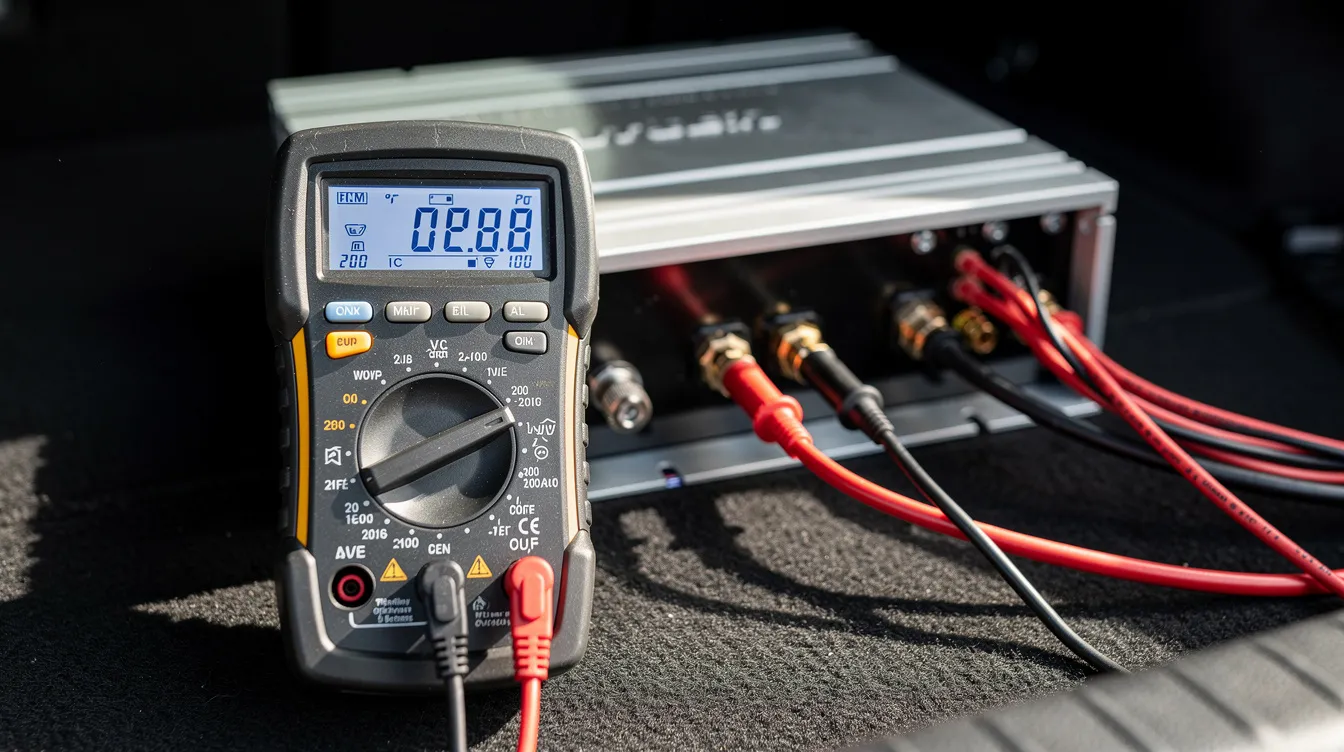
To check power, set a digital multimeter to DC volts and test the 12V Constant Power at the amp. When possible, do this with the car's engine running, since charging voltage should normally be in the 12V to 14.4V range. If the amp voltage drops hard during bass hits, the car amp may shut off.
Common Ground Issues
A common cause for an amplifier to cut out is a poor ground connection; if the ground wire is not securely connected, it can lead to intermittent power loss. A loose or dirty ground connection can cause significant electrical resistance in an amplifier. Painted metal, a loose bolt, a thin ground, or a long ground run can make a healthy amp look dead.
We once saw a Conover, NC customer with dimming lights and an amp cutting out. The issue was not too much power—it was corrosion under the chassis ground. Cleaning to bare metal and re-crimping the connecting wires fixed it.
Amped Up Car Audio recommends matching wire gauge to current draw. Mid-power systems often need 4 AWG OFC; bigger systems may need 0 AWG, batteries, or alternator upgrades.
Remote Turn-On & Head Unit Problems: Amp Has Power But Won’t Turn On
Understanding the Remote Turn-On Lead
The remote turn-on lead is usually a blue or blue-white wire from the head unit. The remote turn-on wire signals the amplifier to power on when the car stereo is activated, and it should read above 11V for proper functionality.
How to Test the Remote Turn-On
Test it like this:
-
Key in ACC/ON.
-
Black meter probe to amp ground.
-
Red probe to REM terminal.
-
Look for roughly 12V, and definitely above 11V.
If your amplifier doesn't power on, check the remote turn-on wire, power wire, and ground connection to ensure they are properly connected and functioning.
For testing only, you can briefly jump the amp’s +12V terminal to REM. If the amp turns on, the amplifier may be fine and the remote circuit is the issue. Do not leave it jumped; it can drain the battery overnight.
Common Remote Circuit Failures
Common failures include a bad head unit remote output, the remote tied into a power antenna lead, a weak LOC output, or DSP/bass knob wiring muting the system. Also check any in-line switches, amp plugs, amp wires, and active wires between the stereo and amp.
Protect Mode: When Your Car Amp Turns On But Refuses to Play
What Is Protect Mode?
If the protection mode LED on a car amplifier stays illuminated, it indicates that the amp is in protection mode, which can be triggered by various issues such as short circuits or overheating. If the protect mode light on your amplifier is illuminated, it may indicate a faulty speaker, subwoofer, or cable, and you should check each component individually.
Step-by-Step: Diagnosing Protect Mode
Safe sequence:
-
Turn the system off.
-
Disconnect speaker outputs.
-
Power cycle the amp.
-
If protect clears, inspect speaker wires, speaker enclosure terminals, and speaker connections.
-
If needed, unplug RCA cables and test again.
Speaker Impedance and Overheating
The impedance of connected speakers or subwoofers must not drop below the amplifier's rated capacity to avoid triggering protection mode. Use an ohmmeter at the amp terminals to confirm the final load. A 1Ω sub setup on a 2Ω-stable amp will cause problems.
Overheating is a frequent reason for amplifiers to shut off; if an amp is not well-ventilated or is overloaded, it may enter protection mode to prevent damage. Car amplifiers generate heat during operation, and proper ventilation is essential to prevent overheating.
If the amp stays in protect with the amplifier disconnected from speakers and RCAs, suspect internal damage.
Troubleshooting When Your Amp Powers On But There’s No Sound
If the amplifier has a healthy green light but produces no sound, it indicates an audio signal chain issue.
Start with the basics:
-
Confirm the RCA source from the head unit.
-
Testing RCA signal inputs is crucial; ensure they are connected correctly to the pre-amp audio outputs rather than the video ports.
-
Try known-good RCA plug cables or a portable test source.
-
Check gain, input mode, crossover, LPF/HPF, and subsonic filter.
-
Verify fader, balance, subwoofer on/off, DSP mute, and time alignment.
-
Test one known-good speaker with short speaker wire directly at the amp.
A “dead sub” complaint in our shop once came down to LPF/subsonic settings and gain being misconfigured after a battery reset. No hardware was replaced, and sound quality came back immediately.
Also check bridged mode, slave/subordinate mode, and whether the amp is expecting signal from a master unit.
Fixing Sound Crackling, Hissing, and Intermittent Cuts From Car Amps
Constant hiss usually means noise floor or interference. Crackling and popping usually point to loose connections, clipping, failing speakers, or sound wires connecting poorly.
Best practices:
-
Keep RCA wires running away from power wires.
-
Cross signal and power at 90 degrees when needed.
-
Use shielded RCAs.
-
Tighten all speaker terminals.
-
Inspect exposed wires, broken wires, blown wires, and burnt out wires.
-
Secure all the wires with plastic wire ties after testing.
Sound distortion from an amplifier can often be traced back to loose or burnt wires, which may require inspection and replacement to resolve the issue. Fixing sound crackling also means checking EQ boosts. Heavy 40–60 Hz bass boost or 10–15 kHz treble boost can force clipping early.
Using high-quality wiring and ensuring proper power matching between the amplifier and speakers can help reduce the risk of overheating. Amped Up Car Audio can help pair amps, subs, speakers, batteries, and sound wires so your system plays loud without chronic distortion.
When Your Car Amp Turns On and Off (Or Cuts Out at High Volume)
If your car amp not working issue only happens when the volume is up, think undervoltage, poor ground, overheating, or low impedance.
Monitor voltage at the amp while playing a bass-heavy track at your normal max volume. If voltage falls near or below 11V, the amp may enter protect. Stock alternators and weak batteries struggle with large Class D systems, especially when wiring is undersized.
Check these first:
-
Battery and alternator health
-
Ground length and contact point
-
Final subwoofer impedance
-
Airflow around the amp
Amps hidden under carpet, behind trim, or stacked tightly can overheat. Amplifiers designed with efficient heat dissipation features, such as heatsinks or built-in fans, are less likely to overheat compared to cheaper models.
For large systems, consider an AGM battery, secondary battery, Big 3 wiring, or high-output alternator.
Fuses, Shorts, and Burnt Smells: Is Your Car Amp Blown?
Blown fuses are warnings. Do not keep replacing them without diagnosis.
Inspecting both the amplifier chassis fuse and the main inline power wire fuse near the battery is essential for troubleshooting power issues. Use a multimeter continuity test because the small metal wire inside a fuse can crack where you cannot see it. This applies to normal car fuses, plug fuses, and a glass tube fuse. If shopping for a glass tube online, match the same amperage rating and style; do not assume higher amp ratings lead to a safer fix.
To diagnose a blown car amp fuse, replace the fuse with everything turned off; if it blows again, there may be a short in the wiring or an internal problem with the amplifier. If a fuse blows repeatedly after a correct fuse installed, stop.
Warning signs of a blown amplifier include strange popping noises from the speakers, a burning smell, or visible smoke. If the protection indicator light on your amplifier remains on with nothing plugged in, it may indicate a blown amp.
Before touching the red wire, red power cord, or red power wire, disconnect the negative terminal. A car audio power cord is part of a high-current electrical circuit, not like a wall outlet device.
Basic Tools & Techniques For Diagnosing a Car Amp Not Working
Having the right tools makes troubleshooting faster and safer.
You need:
-
Digital multimeter
-
Test light
-
Wire brush or sandpaper
-
Screwdrivers and socket set
-
Electrical tape
-
Spare fuses with the same amp rating
-
Zip ties
-
Known-good RCA and speaker wire
Test DC voltage at power and remote terminals. Test continuity through speaker wires. Test resistance to verify speaker impedance. Clean battery, chassis, and amplifier grounds until shiny bare metal is visible.
Inspect the full power run for chafing through the firewall, crushed insulation under trim, melted areas near the engine bay, and bad wire connections. Separate electrical wires for power from signal cables when possible.
A note on wording: people may call them amp wires, positive and negative wires, negative wires, sound wires, wires connecting, or car or home wiring. In car audio, the important part is identifying power, ground, remote, RCA signal, and output wiring correctly.
Do not clean electronics with basically compressed air mixed with moisture. Dry basically compressed air can help remove dust, but contact cleaner and proper inspection matter more.
Choosing the Right Replacement Car Amp (When It’s Really Dead)
After testing, some amps are truly failed. Replacing one is a chance to improve reliability.
Match the new amp by:
-
RMS power, not peak numbers
-
Speaker or subwoofer impedance
-
Channel count: mono, 4-channel, or 5-channel
-
Class D for efficient subwoofer power or Class AB for many full-range builds
-
Electrical capacity of the vehicle
Cheap no-name car amps with unrealistic numbers often create heat, clipping, and shutdown issues. Look for real RMS ratings, protection circuitry, quality terminals, and a design that can actually deliver rated output.
While tube guitar amps and home audio amps are different, the same reliability rule applies: match power and impedance correctly. In a tube amp, you would let the offending tube cool before service; in a vehicle, you disconnect battery power before servicing.
Why Buy Your Next Car Amp & Wiring From Amped Up Car Audio?
At Amped Up Car Audio, we are a specialized car audio retailer with an online store in Conover, NC. We troubleshoot car amp not working issues every day, so our recommendations come from real installs—not just spec sheets.
We carry:
-
Car amplifiers and car amps for subs or full-range speakers
-
Complete amplifier wiring kits
-
Premium subwoofers and speakers
-
High-performance batteries
-
Power management accessories, including eco bass knobs
Our team helps customers choose gear that can deliver rated power without chronic overheating, clipping, or voltage drop. Online customers get fast shipping, detailed product descriptions, and support by phone or email when diagnosing power and wiring issues.
One customer came in with repeated cut-outs and poor bass. We replaced an underpowered amp, upgraded undersized wire, corrected the ground, and matched the system to a more efficient Class D monoblock. The cutting out stopped, and the system played clean.
If you are comparing amp suppliers, browse Amped Up Car Audio’s amplifier and wiring categories or contact us with your vehicle, gear list, and goals.
FAQs: Common Questions About a Car Amp Not Working
What causes a car amp to suddenly lose power?
Usually a blown inline fuse, bad ground, voltage drop on the power wire, loose battery connection, bad power supply, or failed remote turn-on. Check the main fuse, amp chassis fuse, ground, and REM voltage first.
How do I know if my car amplifier is blown and not just in protect mode?
Disconnect RCAs and speaker outputs, leaving only +12V, ground, and remote. If it still stays in protect, smells burned, shows smoke damage, or trips fuses, the amplifier may be blown.
Can a car amplifier drain my battery overnight?
Yes. A miswired remote wire can keep the amp on after the key is off. Test whether the amp shuts down with the vehicle off, and use a multimeter to check current draw if needed.
Why does my amp get hot and shut off so fast?
Poor ventilation, low impedance, too much gain, weak power/ground wiring, or overloaded speakers can cause fast overheating. Improve airflow and verify the load.
How can I fix sound crackling and hissing from my car amp?
Separate RCA cables from power wires, improve ground quality, set gain correctly, replace damaged cables, and check speaker terminals. Shielded RCAs and correct routing often reduce engine whine.
When should I stop troubleshooting and bring my system to a shop?
Stop if you see broken or scorched fuses, smoke, melted insulation, repeated fuse failure, or if you are unsure around high-current wiring. Amped Up Car Audio offers in-shop help in Conover, NC.
Why did a website show security verification while I was shopping for amp parts?
Some sites use a security service before checkout. If you see verification successful, continue only if the site is trusted and you are buying the correct fuse, wire, or amplifier part.
Final Checklist Before You Replace Your Car Amp
Replacing a car amp should be the last step after a clear diagnostic checklist.
Before buying new gear, verify:
-
Battery voltage and power wire integrity
-
Inline and onboard fuses
-
Clean ground on bare metal
-
Remote voltage above 11V
-
Known-good RCAs
-
Correct speaker impedance
-
No shorts on outputs
-
Correct gain and crossover settings
-
No loose, exposed, or melted wiring
Keep a dated log of changes such as “replaced power wire” or “installed new sub.” It makes future troubleshooting much easier.
If your car amp not working problem still is not solved, contact Amped Up Car Audio with your vehicle, current gear list, symptoms, and goals. We will help you decide whether you need a wiring fix, power upgrade, or the right replacement amplifier.