
CCA vs OFC Wire: Which Is Better for Car Audio?
Posted by Jacob Morris on Jun 21st 2026
CCA vs OFC Wire: Which Is Better for Car Audio Systems?
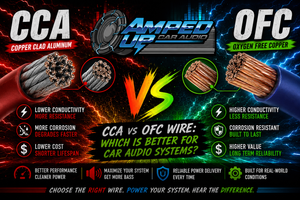
OFC wire is up to 40% more conductive than CCA, delivers cleaner signals and more power, and lasts significantly longer under the demanding conditions of a car audio system. OFC (oxygen free copper) and CCA (copper clad aluminum) are two common types of wire used in car audio systems. CCA wire costs less upfront but carries higher resistance, generates more heat, and degrades faster—especially on long power wire runs and high-wattage builds. This guide is for car audio enthusiasts, installers, and anyone choosing power wire for their vehicle.
When deciding between OFC and CCA, consider performance needs versus budget constraints. This comparison breaks down conductivity, durability, cost, and real-world car audio performance so you can choose the right wire for your next install.
CCA vs OFC Wire: Key Differences
The core difference between CCA and OFC is material composition and the electrical performance that follows.
-
CCA (copper clad aluminum) consists of an aluminum core coated with a thin layer of copper. The copper content is typically only 10–15% by volume-enough to improve surface connectivity but not enough to match pure copper performance.
-
OFC (oxygen free copper) is copper refined to 99.95%+ purity with oxygen content reduced to ≤0.001%, eliminating impurities that cause oxidation and reduce conductivity.
CCA focuses on cost savings and weight reduction at the expense of electrical performance. OFC prioritizes maximum conductivity, heat resistance, and long-term reliability for demanding car audio systems. Understanding these material differences is essential for choosing wire that matches your system's power delivery requirements.
Conductivity and Electrical Performance
Conductivity determines how efficiently electricity travels from your battery through your power cable to your amplifiers and speakers. Higher conductivity means lower resistance, less voltage drop, and better sound quality from your audio equipment.
CCA Wire Conductivity
CCA has about 61% of copper's conductivity. The aluminum core-which makes up 85–90% of the conductor's cross section-provides roughly 61% IACS (International Annealed Copper Standard), compared to copper's ~100% IACS. The thin layer of copper on the outside cannot compensate for the aluminum's electrical limitations.
This higher resistance translates directly to greater voltage drop, particularly on longer wire runs. Over a 10-meter run with 12 AWG wire carrying 10 amps, CCA wire drops approximately 0.80 V compared to just 0.52 V for OFC-a roughly 54% higher voltage loss. That's a big difference when your amp needs every volt to perform at its rated output.
Thicker CCA wire is needed to match OFC performance. AWG sizing is based on the conductor's physical cross-sectional area, so the gauge itself refers to size regardless of conductor material. Industry guidelines recommend stepping up by 1–2 AWG sizes when substituting CCA for copper wire to carry the same current load safely, and fine-strand construction does not change that basic sizing standard.
OFC Wire Conductivity
OFC wire delivers ~100% IACS conductivity with a resistivity of approximately 0.0171 Ω·mm²/m at 20°C. This superior conductivity means lower resistance and efficient power transfer from battery to amplifiers and speakers across every single run in your system.
OFC wire maintains consistent voltage delivery even on longer power wire runs in larger vehicles-critical for SUVs, trucks, and vans where wiring from the battery to trunk-mounted amps can stretch 15–20 feet. This makes OFC ideal for high-output car audio systems, Big 3 electrical upgrades, and multi-amplifier setups where every fraction of a volt matters.
Durability and Corrosion Resistance
Wire longevity directly affects system reliability, maintenance costs, and whether you'll need to tear apart your build to rewire in a few years.
CCA Wire Durability
The aluminum in CCA is highly susceptible to corrosion, especially at exposed points. Aluminum oxidizes rapidly when exposed to moisture and temperature changes, forming aluminum oxide (Al₂O₃)-a resistive layer that degrades electrical contact quality over time.
Galvanic corrosion occurs at the connection point where dissimilar metals meet-aluminum conductor contacting copper terminals or lugs. This is especially problematic in a salty environment, near the engine bay, or anywhere moisture can reach exposed connections. The result is increased resistance over time, leading to heat buildup and potential connection failure.
Under aggressive conditions-heat cycling, vibration, and moisture exposure common in vehicles-CCA wiring may degrade in 3–5 years, requiring inspection and potential replacement.
OFC Wire Durability
OFC resists corrosion better than CCA. Pure copper's high purity minimizes impurities that accelerate oxidation, maintaining lower resistance and stable electrical properties over years of use.
Copper's heat resistance prevents degradation under high-current car audio loads, and it handles thermal expansion with less fatigue than aluminum during repeated temperature cycles. OFC wiring can last over 10 years with proper installation, making it a long-term investment that reduces maintenance and replacement costs.
For under-hood or harsh-environment cables, tinned or silver-coated OFC provides even greater corrosion resistance against salt water exposure and extreme moisture.
Cost and Value Analysis
Upfront price and long-term value tell very different stories when comparing CCA vs OFC.
CCA Wire Cost Benefits
CCA is significantly cheaper than OFC, often 60–70% lower material cost. This lower initial purchase price appeals to budget-conscious car audio enthusiasts building entry-level systems.
CCA is lightweight and easier to route through tight spaces compared to OFC, with a density roughly 40% that of copper. This reduces shipping costs for online orders and simplifies routing through cramped vehicle interiors.
CCA delivers acceptable performance for entry-level systems under 500 watts with short power and ground runs. It's suitable for temporary installations, basic electrical upgrades, or budget-focused projects where the system won't be pushed hard.
OFC Wire Value Proposition
In serious builds, wire quality can matter more than the initial price difference, which is why OFC's higher upfront cost is justified by superior performance and longevity. Investing in OFC allows for future upgrades without rewiring-if you move from a 500W amp to a 1,500W setup, properly sized OFC copper wire already has the headroom to handle it.
Better sound quality and system efficiency provide lasting value. OFC delivers cleaner signals and more power to your amplifiers, ensuring you hear what your audio equipment is capable of rather than what the wrong wire is limiting it to.
OFC is essential for professional installations, competition-level car audio systems, and any build where reliability is non-negotiable.
Car Audio System Performance Impact
Wire choice has a direct, measurable effect on sound quality, power delivery, and system reliability.
CCA Performance in Car Audio
Voltage drop from CCA's more resistance causes amplifier clipping and reduced output power at high volumes. When an amp doesn't receive its full rated voltage, it compensates by distorting-particularly noticeable in bass response and dynamic range.
CCA tends to hold about 30% more heat than OFC, increasing the risk of thermal runaway. CCA wire heats up faster, posing safety risks-especially at termination points and in hot zones near the engine bay or firewall. This heat can damage wire insulation and degrade connections over time.
Signal degradation affects bass response and overall audio clarity. For this reason, CCA is best for lower-power audio systems, budget-focused projects, and short runs where the performance gap is less pronounced.
OFC Performance in Car Audio
Maximum power transfer ensures amplifiers receive full rated voltage for optimal performance. With lower resistance across every foot of the power wire run and ground return, OFC keeps your system operating within its designed parameters.
Clean signal delivery maintains audio fidelity and dynamic range across the entire frequency spectrum. Superior current handling supports high-output subwoofers and multi-amplifier setups where current demands can exceed 100 amps.
OFC is mandatory for long runs and high-power systems according to experienced installers and audiophiles. It's the preferred choice for SPL competition and audiophile-quality installations where every detail in sound quality matters.
Installation and Safety Considerations
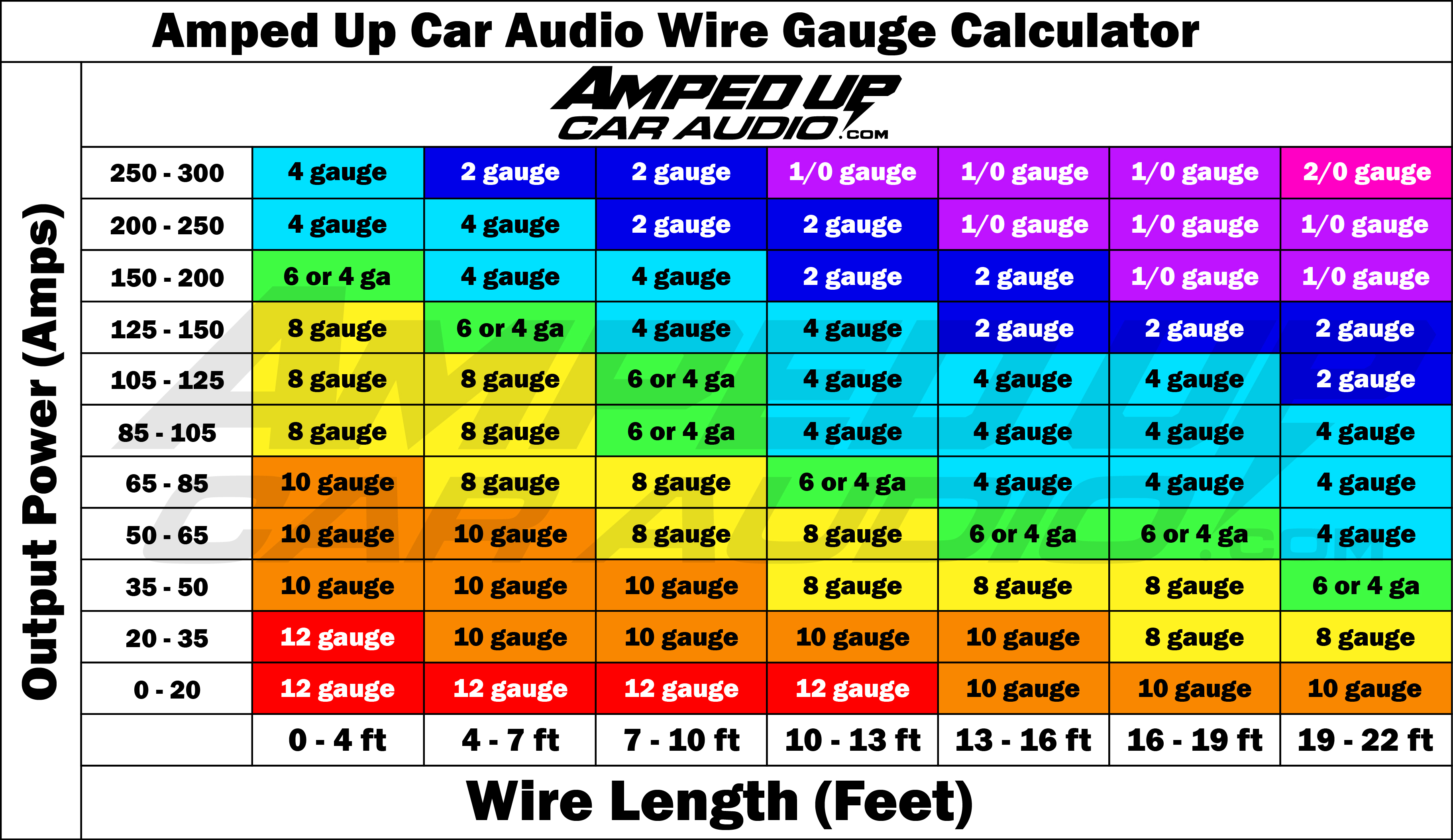
Wire gauge sizing requirements differ significantly between CCA and OFC for equivalent performance. When using CCA, you must use a larger gauge to compensate-if OFC requires 4 AWG OFC for 60 amps over 10 feet, use 2 AWG for CCA to achieve similar current capacity.
CCA installations require careful attention to connection points. Use copper lugs with full contact, apply dielectric grease or heat shrink to seal connections, and prevent moisture intrusion that accelerates galvanic corrosion between dissimilar metals. If the copper cladding is breached during stripping or crimping, the exposed aluminum core will oxidize and create a high-resistance hot spot.
OFC provides more installation flexibility and better heat management. Its consistent conductor composition means terminations are more reliable and less prone to degradation. Proper fusing close to the battery is essential regardless of wire type chosen-and ground runs should be similarly sized to power runs to avoid ground-side voltage loss.
All conductors in car audio should be stranded rather than solid for flexibility and vibration tolerance. Higher strand counts improve the wire's ability to handle the constant movement and vibration of a vehicle environment.
Note on skin effect: while sometimes mentioned in CCA vs OFC discussions, skin effect is negligible for the DC and low-frequency power runs in car audio systems. It becomes a factor only at much higher frequencies.
CCA vs OFC: Which Wire Should You Choose?
Use CCA for systems under 500 watts RMS with short wire runs and temporary installations where budget is the primary concern. If you go with CCA, size up your wire gauge by 1–2 sizes, use quality terminations, and plan for more frequent inspections.
Choose OFC for high-performance systems, Big 3 upgrades, long power cable runs, and professional-grade installations. OFC is ideal for high-output systems and long power runs where voltage drop, heat management, and reliability are critical.
System wattage, wire run length, environmental exposure, and future upgrade plans determine the best choice. For serious car audio enthusiasts and professionals, OFC provides better long-term value-eliminating the need to rewire when you upgrade your amp or add a second subwoofer.
Frequently Asked Questions
Can I mix CCA and OFC wire in the same system? You can, but the CCA portion becomes the weakest link in your electrical chain. Performance will be limited by the CCA section's higher resistance, and junctions between the two materials create potential points for galvanic corrosion unless properly sealed with dielectric grease or heat shrink.
How much larger should CCA wire be compared to equivalent OFC gauge? Generally 1–2 AWG sizes larger. For example, if your system calls for 4 AWG OFC, you should use 2 AWG CCA to compensate for CCA's approximately 61% conductivity of copper. Exact sizing depends on run length and current draw-consult an AWG and ampacity chart for precise calculations.
Does wire type affect amplifier warranty coverage? It can. Some amplifier manufacturers specify minimum wire gauge and recommend copper conductors. Using undersized CCA that leads to voltage drop and overheating could result in a failure not covered under warranty. Check your amp manufacturer's installation guidelines.
What gauge wire do I need for my specific amplifier wattage? This depends on your amp's current draw, wire run length, and conductor material. Use our guide on how much electrical you need for car audio to determine the correct gauge for your specific setup.
How can I identify CCA vs OFC wire when shopping? Check product specifications for IACS percentage, conductor material, and cross section details. Physically, you can cut the wire and inspect the cross section-CCA shows a silver-colored aluminum core beneath the copper coating. Price is also an indicator: if a 0-gauge "copper" wire kit seems unusually cheap, it's likely CCA. Buy from trustworthy brands that clearly label conductor material.
Is the performance difference audible in real-world listening? At high volumes and low frequencies-especially bass-heavy music-yes. Voltage drop from CCA reduces bass dynamics and can cause audible clipping. At moderate listening levels with low-power systems, the difference is less pronounced but still measurable in available power headroom and amplifier efficiency.
Which wire type works better in extreme temperature conditions? OFC performs better in both extreme heat and cold. Copper handles thermal expansion with less fatigue, maintains conductivity across wider temperature ranges, and resists insulation breakdown in engine bay heat. CCA is more prone to oxidation, insulation failure, and connection degradation under temperature cycling.
What's the maximum safe wattage for CCA vs OFC wire? There isn't a single number-it depends on wire gauge, run length, and fusing. However, most experienced installers and brands recommend CCA only for systems under 500–800 watts RMS with short runs. For systems above 1,000 watts, OFC is strongly recommended for safe, reliable power delivery.
Shop Premium OFC and Budget CCA Wiring at Amped Up Car Audio
Choosing wire shouldn't be a guessing game. At Amped Up Car Audio, we carry expert-selected OFC and CCA wiring options for every budget and application-from entry-level speaker wire to competition-grade power cable.
Browse our complete wiring kits with proper gauge sizing matched to your specific system requirements. Every kit includes the connectors, fusing, and hardware you need for a clean, safe install.
Need help choosing wire for your build? Our car audio experts provide professional installation guidance and technical support to make sure you get the right conductor material, the right gauge, and the right terminations for your setup. Contact us today and get your next install wired right.