
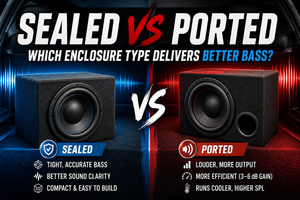
Sealed vs Ported Subwoofer: Which Offers Better Bass Performance?
Posted by Jacob Morris on Jun 21st 2026
Sealed vs Ported Subwoofer: Which Enclosure Type Delivers Better Bass?
Choosing between sealed and ported subwoofer enclosures affects sound quality, output levels, installation space and power requirements. The right enclosure depends on your music preferences, available space and whether you prioritize accuracy or maximum volume.
Below is a comprehensive comparison of sealed vs ported subwoofer enclosures for car audio systems.
Sealed vs Ported Subwoofers: Key Differences
The main difference comes down to control versus raw output.
-
Sealed enclosures deliver tight, accurate bass with controlled cone movement and precise frequency response. The sealed box traps the driver's rear wave, using internal air as a spring to damp motion, reduce distortion, and help prevent panel or interior rattle.
-
Ported enclosures produce louder, more efficient bass output through a tuned port that reinforces low frequencies. Ported Subs use the port's air column, which vibrates in phase with the driver's front wave, to generate more output from the same amplifier power.
-
Sealed boxes require less space and are easier to build with no port tuning requirements. Sealed enclosures are smaller and easier to build than ported ones.
-
Ported boxes need larger volumes and precise port length and diameter calculations for optimal performance. Ported enclosures are generally larger, requiring 30–60% more internal volume than a comparable sealed box.
Both designs can produce excellent bass response when properly designed and matched to quality components.
Sound Quality & Performance Characteristics
Sound quality is the main reason many enthusiasts agonize over the ported vs sealed decision. Each enclosure type shapes the bass you hear in fundamentally different ways.
Sealed Subwoofer Sound Quality
Sealed subwoofers provide tighter, more accurate bass. The airtight cabinet acts as an acoustic suspension system, producing a gentle second-order roll off (~12 dB/octave) below the driver's resonance frequency. This natural, gradual decline preserves useful output even at very low frequencies.
Sealed boxes reduce group delay, improving sound clarity. At 30 Hz, a sealed enclosure typically produces only 8–10 ms of group delay, which translates to better transient response and cleaner kick drums. Sealed designs are preferred by listeners who want clean and punchy bass-fast percussive hits reproduce with minimal ring or overshoot.
Sealed subwoofers are ideal for music genres that require fast bass response. The flat response characteristics above resonance and controlled behavior below it make sealed subs versatile across rock, jazz, classical and mixed-genre listening.
Ported Subwoofer Sound Quality
A ported subwoofer generates louder, more resonant bass with emphasis at the tuning frequency. Within that tuned band, the port reinforces the driver's output, delivering a sense of deep bass impact that can be heard and felt throughout the cabin.
However, ported subwoofers may produce unwanted sounds if not designed well, known as "port chuffing"-turbulence noise caused by air moving too fast through an undersized or poorly shaped port. Below the tuning frequency, output drops sharply at a fourth-order rate (~24 dB/octave), and the driver can move uncontrolled without the port's damping assistance.
Ported enclosures excel with hip-hop and EDM music, where sustained low end pressure and maximum bass impact matter more than razor-sharp transient accuracy. A properly designed ported enclosure can sound excellent, but a poorly tuned one often sounds boomy or loose-a critical trade off that demands precision during the build.
Output & Volume Capabilities
When it comes to sheer loudness and SPL, the difference between sealed and ported designs is significant and measurable.
Sealed Enclosure Output
Sealed enclosures require more amplifier power for the same output as ported designs. The sealed box's inherent damping absorbs energy, which means the speaker needs more power to move air at the same volume level. For listeners focused on sound quality at moderate volume, this is rarely a problem-but for those chasing high output levels, it's a real constraint.
Sealed subs provide consistent output across their usable frequency range without the peaks and valleys that can color ported bass response. They're better suited for systems where accurate reproduction matters more than maximum SPL. In car audio, cabin gain (the natural +12 dB/octave boost from a vehicle's enclosed interior below 70–90 Hz) can offset the sealed box's gentle roll off, making a sealed subwoofer sound deeper in a car than bench measurements might suggest.
Ported Enclosure Output
Ported enclosures can produce more output from the same amplifier power-typically 3–6 dB higher output at the tuning frequency than a comparable sealed box. That 3–6 dB gain represents roughly a doubling of acoustic energy, which is a substantial difference you can absolutely hear.
Ported subwoofers can achieve higher maximum SPL levels, making them the preferred choice for SPL competition and maximum loudness applications. The ported design is also more forgiving of underpowered amps-if your amplifier budget is limited, a ported enclosure lets you get more bass per watt.
Additionally, ported subwoofers run cooler due to airflow from the port. The moving air provides natural voice coil cooling, allowing higher sustained power handling during extended listening sessions. This thermal advantage matters for anyone pushing their system hard.
Enclosure Size & Installation Requirements
Available space is often the deciding factor for car audio installations, and the size difference between sealed and ported boxes is substantial.
Sealed Box Dimensions
A sealed box for a 10–12 inch woofer typically requires just 0.5–1.5 cubic feet of internal volume. This compact design fits easily in trunks, under seats or in custom-fabricated spaces where every inch counts.
Construction is straightforward: a simple rectangular cabinet with an airtight seal. There's no port to route, no port length to calculate and no concern about airflow clearance. The smaller footprint also provides flexible placement options-sealed boxes can be oriented in almost any direction without affecting performance, and mounting depth is the primary dimensional concern.
Ported Box Dimensions
Ported boxes are generally larger, requiring 1.5–3.5 cubic feet per driver depending on the target tuning frequency. The enclosure must accommodate not only the internal volume the driver needs but also the port itself, which must have sufficient cross-sectional area to avoid turbulence at high output levels, and in many builds the vent or line path also takes up usable box space.
Port placement adds another layer of complexity. The port opening needs clearance-several inches of space behind or around it-to avoid airflow obstructions that degrade performance. In car audio, this can make trunk placement tricky. Precise port length and diameter calculations are essential: errors in port tuning or volume can shift the resonance, reduce output or introduce the muddy bass characteristics that give ported ones a bad reputation.
Power Requirements & System Efficiency
Your amplifier choice and power budget should directly influence your enclosure decision.
Sealed Subwoofer Power Needs
Sealed enclosures require more amplifier power-roughly 25–50% more power to match the output of an equivalent ported design. The sealed box's acoustic suspension absorbs energy that could otherwise move air, so amps need to work harder.
Higher-powered amplifiers with strong damping factors pair best with sealed subs, keeping the driver tightly controlled for that punchy, articulate bass. If you're building a system around a sealed subwoofer, plan your amplifier selection carefully to ensure you have enough headroom. The lower efficiency of a sealed setup demands thoughtful system planning-from your amp channel allocation to your power wire gauge.
Ported Subwoofer Power Efficiency
Ported subwoofers are more efficient with amplifier power. The port resonance provides mechanical assistance to driver movement in the tuned band, effectively doing work that would otherwise require raw amplifier watts. A well-tuned ported enclosure can be 30–50% more efficient than its sealed counterpart, producing 2–4× more output in the deepest bass frequencies.
Better voice coil cooling from port airflow also allows higher sustained power handling. For enthusiasts running heavy bass for extended periods-long cruises, car shows, competitions-this thermal advantage translates to greater reliability and longevity from the same sub and amp combination.
Application Considerations
The best subwoofer enclosure type depends on how you actually listen to music and what you drive.
-
Choose sealed for rock, jazz, classical music requiring accurate bass reproduction. Sealed systems often integrate more cleanly with main speakers when balanced, accurate bass reproduction is the goal. Sealed enclosures are better for rock and classical music, where tight articulation and fast transient response let you hear every note as intended.
-
Select ported for hip-hop, EDM, rap emphasizing deep, loud bass. Ported subwoofers can perform better in larger rooms and vehicles due to their superior output capabilities.
-
Compact vehicles benefit from sealed designs due to space constraints-a sealed box leaves more usable trunk or cargo space.
-
Large vehicles with generous cargo areas can accommodate ported boxes for maximum impact, taking advantage of the ported design's efficiency.
-
Daily driver systems often favor sealed for versatility across music types. The consistent, controlled bass response works well whether you're listening to acoustic tracks or switching to bass-heavy playlists.
-
Ported subwoofers are better for home theater applications due to their ability to reproduce ultra-low frequencies that deliver cinematic explosions, rumble and LFE impact.
-
For those interested in alternatives, passive radiator designs offer a portless vented effect without airflow noise-worth exploring if port chuffing concerns you but you still want more output than a sealed box delivers.
Sealed vs Ported Subwoofer: Which Should You Choose?
Choose sealed enclosures if you want accurate and deep bass with compact installation, versatile music compatibility and a forgiving build process. Sealed boxes provide tighter bass response than ported boxes, and the room gain in your vehicle's cabin naturally extends low-frequency performance beyond what free-air measurements suggest.
Choose ported enclosures if you want maximum output, bass-heavy music focus and you have the space for a larger installation. Ported enclosures are generally louder than sealed enclosures, delivering measurably more sound pressure for the same amplifier investment.
Consider your primary music genres, available space and desired sound character. A sub with a low EBP (Fs/Qes under 50) naturally suits a sealed box; an EBP over 100 points toward a ported design. Between those values, either enclosure can work with careful design.
Both sealed and ported designs can deliver excellent results when properly matched to the right driver, amplifier and vehicle environment. There is no universally better sound system-only the one that's right for your priorities.
Frequently Asked Questions
Are ported subwoofers louder than sealed?
Yes. Ported enclosures are generally louder than sealed ones. A properly tuned ported box typically produces 3–6 dB more output at its tuning frequency than the same driver in a sealed enclosure with the same amplifier. That difference represents nearly double the acoustic energy in the tuned bass range.
Which enclosure type has better sound quality?
Sealed enclosures generally offer tighter, more accurate bass with less group delay-about 8–10 ms at 30 Hz compared to 20–30 ms for ported designs. This makes sealed subs sound more precise and controlled. However, a properly designed ported enclosure can deliver impressive sound quality too. Poorly built ported boxes tend to sound boomy, which is a design problem rather than a fundamental flaw of vented enclosures.
Do ported subwoofers need more power?
No-ported designs are actually more efficient and require less amplifier power for equivalent output levels. Sealed enclosures require more amplifier power for the same output as ported. If you're working with a limited power budget, a ported sub will give you more bass per watt.
Can I build my own subwoofer enclosure?
Yes, but the complexity differs significantly. Sealed enclosures are easier to build-you need proper internal volume and an airtight seal. Ported designs require precise calculations for port length, port diameter and internal volume based on the driver's Thiele-Small parameters (Fs, Qes, Qts). Errors in ported box construction can cause muddy bass, distortion or even driver damage from uncontrolled excursion below the tuning frequency. A subsonic filter is essential for ported installs.
Which lasts longer, sealed or ported subwoofers?
Both enclosure types are equally durable when properly designed. However, ported subwoofers run cooler due to airflow from the port, which reduces thermal stress on the voice coil during sustained high-power use. Sealed boxes trap more air and heat, which can affect long-term reliability at consistently high output levels.
What happens if I use the wrong enclosure volume?
With a sealed box, incorrect volume mainly reduces efficiency-the sub still functions but performance degrades gradually. With a ported box, wrong volume or mistuned port can shift the resonance frequency, produce muddy or distorted bass, or allow the driver to exceed safe mechanical limits below tuning. The consequences of error are significantly more serious with ported designs.
Does cabin gain help sealed subwoofers in cars?
Yes. A vehicle's enclosed cabin provides natural low-frequency amplification of approximately +12 dB/octave below 70–90 Hz. This room gain effect partially compensates for the sealed box's gentle roll off, meaning a sealed sub often sounds deeper in a car than its anechoic specifications suggest.
Get Professional Subwoofer Enclosure Solutions
Choosing between sealed and ported isn't just about reading specs-it's about matching the right enclosure to your specific driver, vehicle and listening style. That's where expert guidance makes the difference between good bass and the best subwoofer system you've ever heard.
-
Browse our complete selection** of high-performance subwoofers** from top brands like Sundown Audio, Crossfire Audio, Down4Sound, DC Audio, and other premium manufacturers—available for both sealed and ported applications.
-
Shop online with Amped Up Car Audio for expert advice, a wide selection of premium subwoofers, and custom enclosure options—all accessible from the comfort of your home. Enjoy fast shipping and dedicated customer support to help you build the perfect bass system remotely.
-
Watch for our upcoming ported box calculator tool-input your driver's Thiele-Small parameters and desired tuning frequency, and get precise enclosure volume, port length and port diameter specifications calculated instantly.
-
Contact Amped Up Car Audio today to design the perfect subwoofer setup for your vehicle and music preferences. Whether you need a compact sealed box for daily listening or a high-output ported enclosure built to competition standards, we'll help you get it right the first time.