
Car Audio Wire Gauge Chart: AWG Sizing for OFC & CCA Wire
Posted by Jacob Morris on Jun 24th 2026
Car Audio Wire Gauge Chart: AWG Sizing for OFC & CCA
Key Takeaways
-
The American wire gauge system uses smaller gauge numbers for thicker copper wire with higher current capacity - a 1/0 AWG wire is thicker than 8 AWG wire and carries far more current.
-
Proper wire gauge selection depends on current draw (amps), run length, and acceptable voltage drop - not just the wattage printed on the box.
-
High-power car audio systems (1,500–8,000W RMS) typically need 1/0 AWG or 2/0 AWG copper power and ground wire, plus upgraded charging through a Big 3 upgrade, high-output alternator, and battery bank.
-
Wire gauge charts help determine safe current-carrying capacity, but real-world conditions like ambient temperature, bundling, and conductor material require conservative sizing.
-
Amped Up Car Audio provides competition-tested recommendations and products based on 23+ years of installation and SPL experience in Conover, NC.
Introduction to Wire Gauges & Why They Matter in Car Audio
Wire gauge is the measurement that tells you how thick a conductor is - and in car audio, it directly controls how much current your power and ground cables can safely carry between your battery and amplifiers. Selection of wire size ensures safety by handling the necessary electrical loads your system demands. Get it wrong, and you invite voltage sag, clipping, dimming headlights, amp protect mode, and in worst cases, melted insulation or fire.
The American Wire Gauge (AWG) system is the standard in the U.S. for specifying wire diameters across industries, from household electrical work to high-output car audio. In AWG, a smaller number means a thicker wire with less resistance and higher current capacity. This guide covers everything from battery-to-amplifier runs and Big 3 upgrades to subwoofer wire and door speaker runs - all organized around a practical wire gauge chart built from real installations and competition vehicles at Amped Up Car Audio.
American Wire Gauge (AWG) Basics
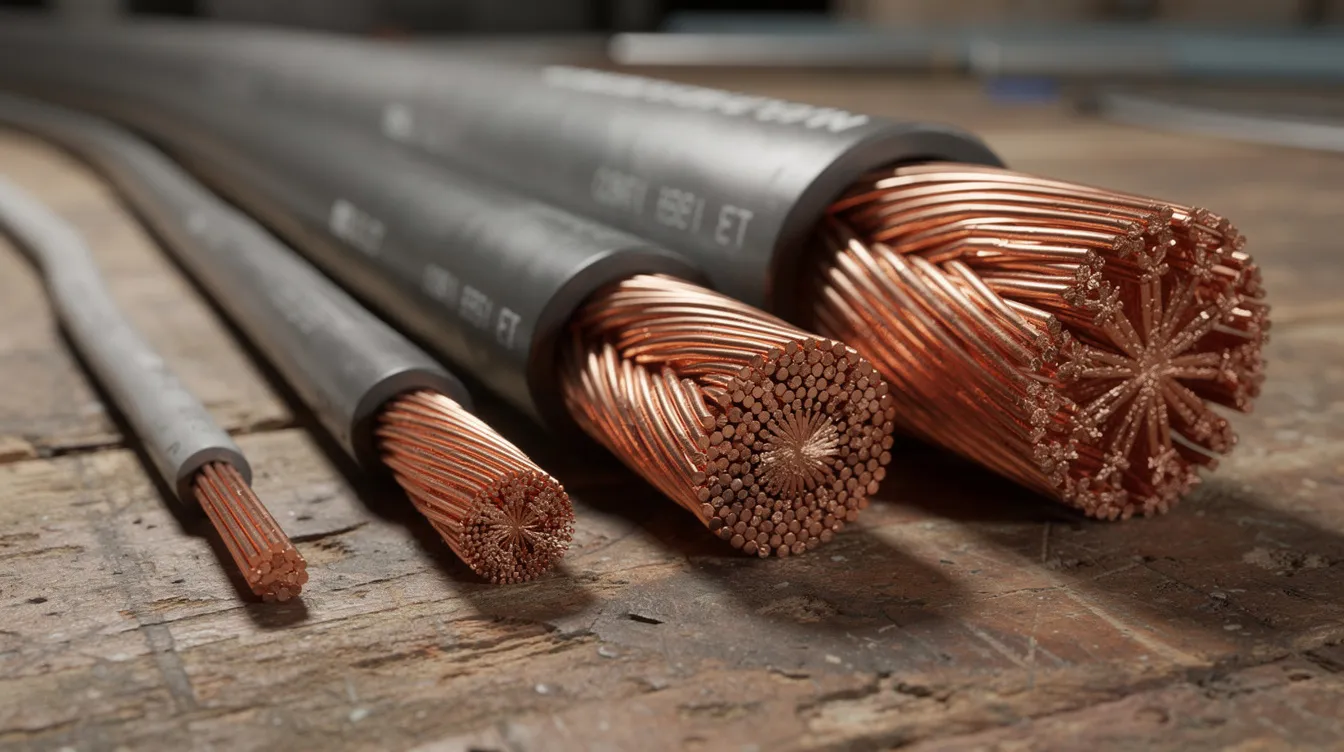
The American wire gauge system originated in the mid-1800s as a way to standardize copper wire drawn through progressively smaller dies. Today, the AWG system assigns numbers to wire diameters throughout North America, and it remains the de facto standard for sizing conductors in automotive, residential, and industrial applications. Outside North America, wire sizes are often based on cross-sectional area in mm² instead.
AWG wire sizes are expressed as gauge numbers: 8 AWG, 4 AWG, 1/0 AWG ("one aught"), 2/0 AWG, and so on. Lower AWG numbers indicate a larger AWG diameter and therefore thicker wire, while higher numbers indicate thinner wires. The system ranges from 40 AWG for fine wire used in electronics to 0000 (4/0) AWG for heavy-duty power transmission. A higher gauge number indicates a smaller wire diameter in the AWG system.
The scaling is logarithmic. Doubling the cross-sectional area of a wire decreases the AWG number by 3 - so dropping from 10 AWG to 7 AWG roughly doubles the copper area. Doubling the diameter of a wire decreases the AWG number by 6. A decrease of 10 gauge numbers roughly multiplies area and conductivity by ten. The resistance of wire is measured per unit length in ohms per 1,000 feet - for example, 4 AWG copper measures about 0.249 ohms per 1,000 ft, while 1/0 AWG comes in around 0.0983 ohms per 1,000 ft.
AWG applies to both solid and stranded copper conductors, but car audio almost always uses flexible, finely stranded OFC cable. Fine wire stranding improves routing through tight vehicle interiors and resists vibration-induced fatigue. For a deeper breakdown, see our Essential Wire Gauge Chart: Understanding AWG and Ampacity Basics.
How to Read a Wire Gauge Chart (Quick Car Audio Reference)
A wire gauge chart is a table linking AWG sizes to current capacity, voltage drop behavior, and typical use cases. For car audio, the chart is organized by AWG wire size in the rows and columns for approximate ampacity at 12–14 VDC, common run lengths, and recommended RMS wattage ranges. Wire gauge charts help determine safe current-carrying capacity so you can match the correct wire size to your system before buying a single foot of cable. This chart data is a guideline and should be checked against the cable manufacturer's specifications for the exact product.
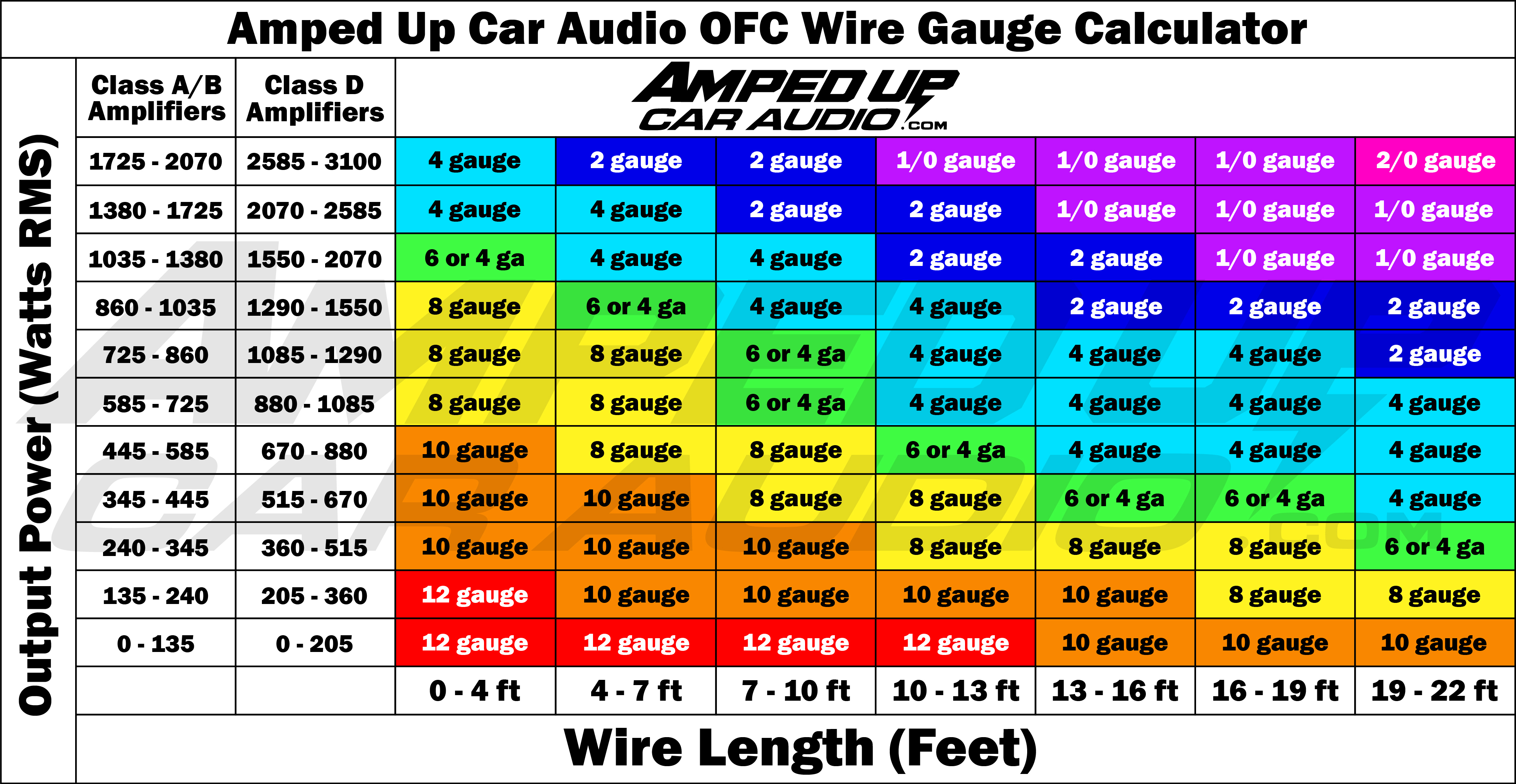
Amped Up Car Audio OFC Wire Gauge Chart — by wattage and run length
This chart assumes quality OFC copper wire, typical car interior ambient temperature around 20–40 °C, and single-run cables - not tightly bundled looms. For CCA or aluminum conductors, upsize at least one full gauge.
Quick Answer: What Gauge Wire Do I Need for My Amp?
Here are fast recommendations for common setups, assuming Class D amplifiers at 70–80% efficiency and OFC copper:
-
500W RMS 4-channel amp, sedan (10–15 ft run): 8 AWG power and ground wire.
-
1,000W RMS sub amp, trunk car (15–18 ft run): 4 AWG copper; consider 1/0 AWG for runs beyond 16 ft.
-
2,500W RMS monoblock, SUV (18–20 ft run): 1/0 AWG OFC minimum. 1/0 AWG wire is recommended for systems over 1,500W RMS.
-
5,000W+ RMS demo build, full-size SUV or van: 2/0 AWG OFC or dual 1/0 runs, with Big 3 upgrade matching the main feed gauge.
Amped Up Car Audio OFC Wire Gauge Chart — by wattage and run length
Power and ground wire must always match gauge. If running older Class AB amplifiers (50–60% efficiency), step up one wire size for safety. When in doubt, Amped Up Car Audio recommends upsizing the wire to reduce voltage drop and future-proof for upgrades.
The Relationship Between Watts, Amps, and Wire Gauge
Wire gauge selection depends on current draw and wire length - not just the amplifier wattage printed on the box. Electricians select wire size based on the required amperage for a circuit, and car audio is no different. The formula that matters:
Current (Amps) = RMS Power ÷ (System Voltage × Amplifier Efficiency)
Using 13.8 V as a realistic car audio system voltage, a 1,500W RMS Class D sub amp at ~75% efficiency draws roughly 145 amps at full output: 1,500 ÷ (13.8 × 0.75) ≈ 145 A. That current draw points directly to 1/0 AWG copper on the gauge chart.
Peak "max" or "dynamic" wattage numbers are marketing. Always size wire based on realistic RMS power. If you're running parallel amplifiers for multiple subs or a multi-amp front and rear stage, sum all RMS wattage and calculate total current before consulting the chart. For help determining how many amps your system actually draws, check our guide on How Much Electrical Do I Need for Car Audio?
Amperage & Current Capacity: Practical AWG Wire Sizing for Car Audio
Ampacity is the maximum current a wire can safely carry without exceeding its insulation temperature rating. In car audio, ampacity refers to the continuous rating - not a brief peak - because long bass-heavy sessions and hot interiors push wires harder than many household lighting circuits. Ampacity depends on wire size, material, and insulation type.
Practical amperage chart for copper wire at typical car run lengths:
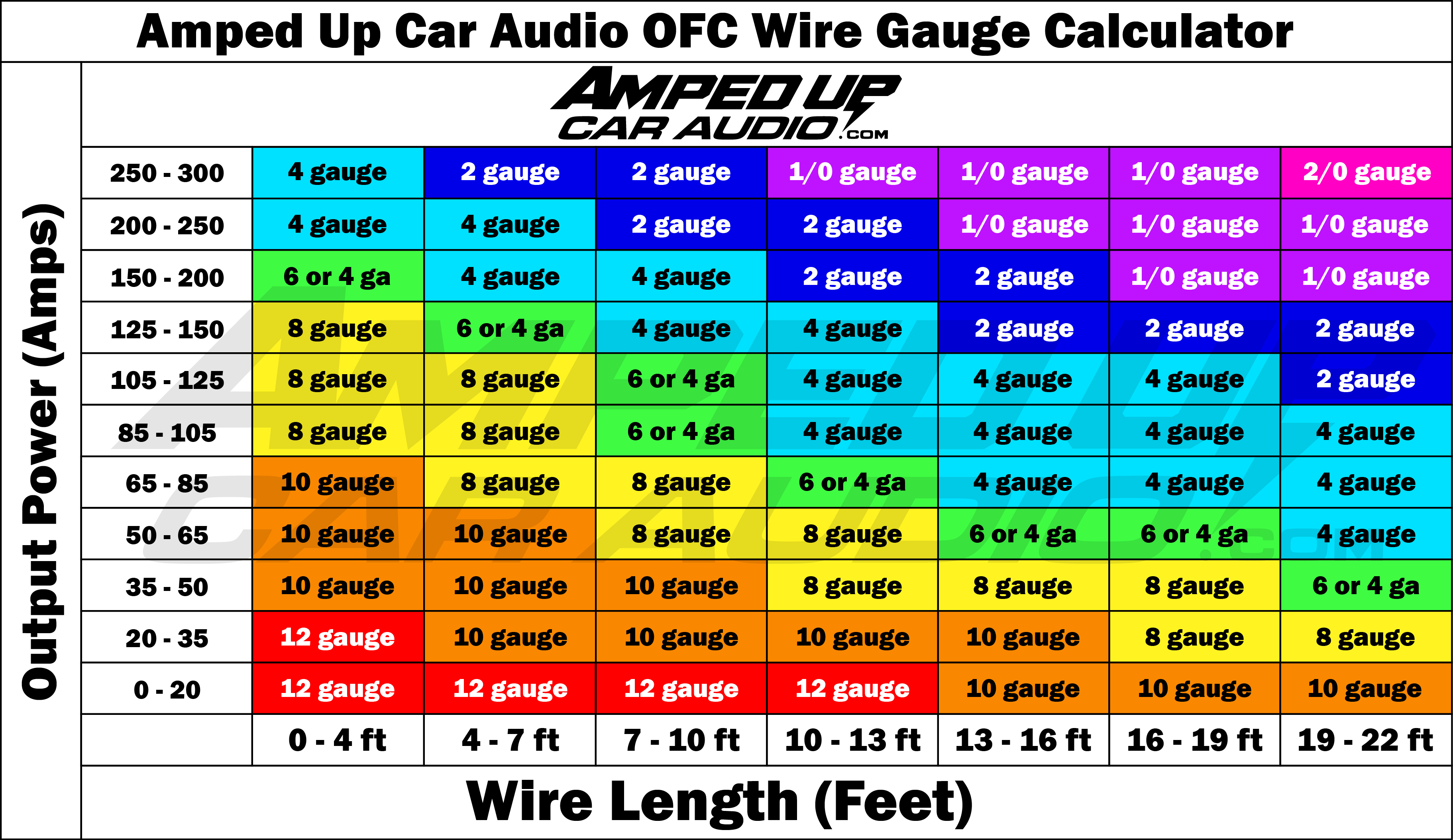
Amped Up Car Audio OFC Wire Gauge Chart — by amps and run length
Aluminum wires have lower ampacity than copper of the same gauge. CCA (copper-clad aluminum) delivers roughly 61% of OFC copper's ampacity at the same labeled conductor size. Amped Up Car Audio strongly prefers oxygen-free copper for serious systems, and every recommendation in this article assumes quality Power/Ground Wire - not undersized CCA cable.
Wire Gauge Chart for Common Car Audio Power Levels
This is the core amperage chart mapping combined RMS wattage and cable run length to recommended AWG sizes for 12–14V car audio systems:
|
Total RMS Power |
Run 0–10 ft |
Run 10–16 ft |
Run 16–20+ ft |
|---|---|---|---|
|
Under 600 W |
8 AWG |
8 AWG |
4 AWG |
|
600–1,500 W |
4 AWG |
4 AWG |
1/0 AWG |
|
1,500–3,000 W |
1/0 AWG |
1/0 AWG |
2/0 AWG |
|
3,000–5,000 W |
2/0 AWG |
2/0 AWG |
4/0 AWG or dual 1/0 |
|
5,000–8,000+ W |
4/0 AWG or dual 1/0 |
4/0 or dual 2/0 |
Multiple parallel runs |
This chart is intentionally conservative, based on real builds Amped Up Car Audio has run in daily drivers and competition vehicles. Systems exceeding 250A continuous draw should consider multiple 1/0 AWG runs or a dedicated 2/0 AWG feed, especially in SUVs and vans with 18–20 ft cable runs. Matching the wire's ampacity to the circuit load prevents overheating or fire hazards.
Voltage Drop, Run Length, and Why Distance Changes Everything
Voltage drop is the loss in voltage between the battery and the load end - your amplifier - caused by the resistance of the wire. It increases with both distance and current. Longer wire runs require larger gauge wire to reduce resistance and keep adequate voltage arriving at the amp.
Even with the correct wire size, long runs (18–20 ft in SUVs or vans) can produce significant voltage sag if the cable is too small. Symptoms include:
-
Headlights dimming on bass hits
-
Amplifiers clipping earlier than expected
-
Bass weakening at high volume
-
Amps going into protect mode
-
Discolored or melted insulation near terminations
As a rule of thumb, size wire to keep voltage drop under about 3% for serious daily systems and under 1–2% for competition-level builds. Always size for the longest single run in the system and upsize the ground and Big 3 wiring to match or exceed that feed. If your amp is overheating, undersized wiring is one of the first things to investigate.
Copper vs. Aluminum Conductors (and CCA) in Wire Gauge Charts
The difference between pure OFC copper wire, aluminum conductors, and copper-clad aluminum (CCA) at the same AWG wire size is significant. Copper has more resistance per foot only when you compare it to... nothing. In reality, aluminum and CCA have considerably higher resistance at the same gauge, causing more voltage drop and lower maximum current capacity.
Most ampacity charts and electronic tables assume copper. Using aluminum or CCA requires upsizing at least one full gauge - for example, 4 AWG copper performs similarly to 2 AWG or even 1/0 CCA in terms of actual power transmission capability. Aluminum conductors can work for very long runs in high-current mobile power systems, but they demand proper lugs and anti oxidant paste at terminations to prevent corrosion. For a full comparison, see our breakdown of OFC vs CCA Wire.
Amped Up Car Audio recommends OFC copper for amplifier power and ground because of its durability, lower resistance, and fewer connection issues in the automotive environment.
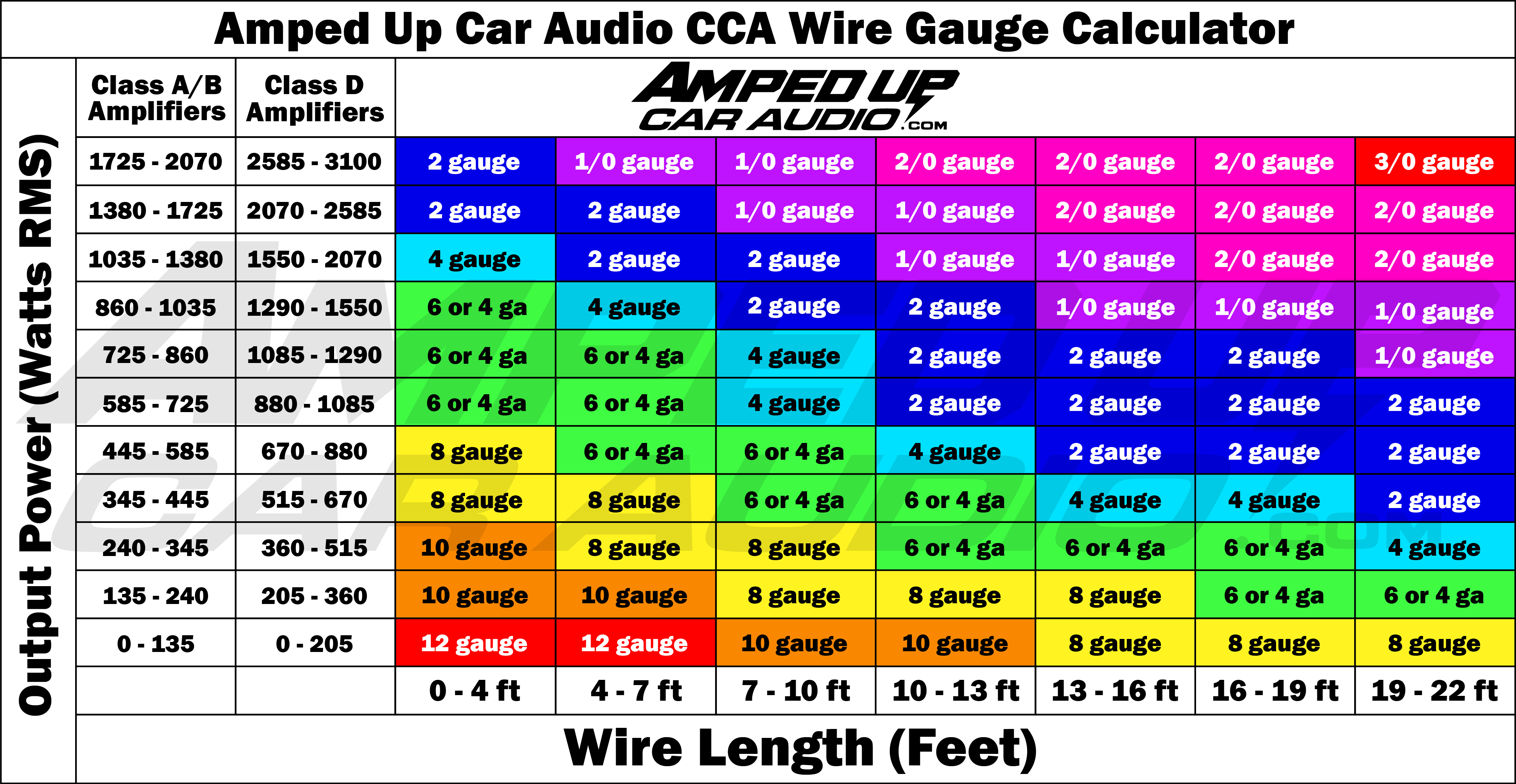
Amped Up Car Audio CCA Wire Gauge Chart — by wattage and run length
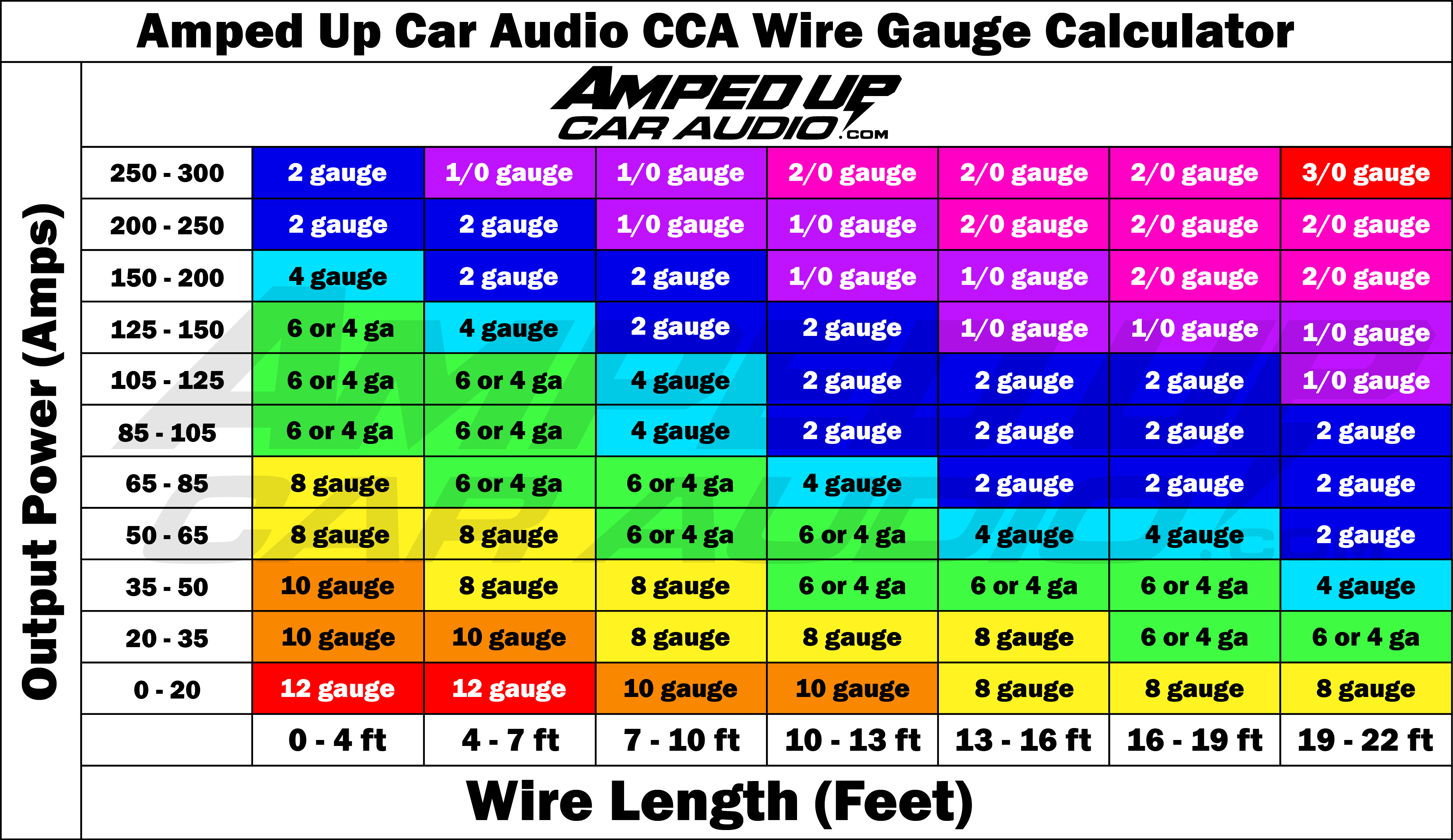
Amped Up Car Audio CCA Wire Gauge Chart — by amperage and run length
Ambient Temperature, Bundling, and Derating in Real Cars
Ambient temperature - the temperature surrounding the wire - directly affects how much current it can safely carry. Under-hood runs can see 80–100 °C, while cabin runs typically sit around 20–40 °C. Ampacity varies based on wire insulation, temperature ratings, and environmental conditions. Ampacity values are affected by ambient temperature and bundling, so manufacturers publish derating tables for exactly this reason.
Wires bundled together in looms, tucked under carpets, or routed through tight body channels cannot cool effectively, so their ampacity must be derated. Treat bundled or hot-routed wire as one AWG size smaller when consulting a standard chart. Vehicles parked in direct summer sun can see interior temperatures above 50 °C, further justifying conservative wire sizing. This is a key reason Amped Up Car Audio is generous with gauge in 2,000W+ RMS systems that see extended demo sessions or competition use.
Speaker Wire Gauge Chart (Front Stage and Subwoofer Runs)
Speaker wire is separate from main power wiring but still governed by gauge, resistance, and voltage drop at audio frequencies. The goal is to keep total wire resistance (both conductors) under about 5% of the speaker's impedance to prevent audible loss.
|
Speaker Power (per channel) |
Run Length |
Recommended Gauge |
|---|---|---|
|
Up to 50 W |
Under 15 ft |
18 AWG copper |
|
50–150 W |
15–25 ft |
16 AWG copper |
|
150 W+ or low impedance (2–4 Ω) |
Any length |
14–12 AWG copper |
|
Subwoofers at 1–2 Ω |
Any length |
12 AWG copper minimum |
High-end active front stages (100W+ per tweeter or mid) benefit from at least 16 AWG copper wire to avoid audible loss at higher listening levels. While AWG numbers are the same as power wire, Speaker Wire in car audio is usually more flexible with clear or colored jackets and should still be pure copper whenever possible.
Pros, Cons, and Termination Practices for Copper and Aluminum
Copper wire advantages include higher conductivity, better flexibility in fine-strand car audio cable, easier termination with common lugs, and fewer corrosion issues in damp automotive environments. Aluminum conductor pros include lower weight and lower cost per amp carried, which can matter in extremely large builds with many parallel cables.
Aluminum and CCA drawbacks include more resistance, more rapid corrosion at lugs, and higher sensitivity to poor terminations. Proper installation requires cleanly stripped wire, and small details in stripping, crimping, and protection make a major difference in connection reliability; lugs should also be crimped or set-screw sized correctly for gauge and strand count, with terminations protected using heat shrink or insulating boots. Amped Up Car Audio's in-house installs use calibrated crimp tools, torque specifications from lug manufacturers, and high-quality OFC cable to maximize current transfer.
Anti-Oxidant Paste and Proper Lugs for Aluminum Conductors
Anti oxidant paste is a conductive, corrosion-inhibiting compound applied to aluminum conductor terminations to prevent oxidation and increased contact resistance over time. This is standard practice per the national electrical code for residential and industrial aluminum wiring, and the same process applies when aluminum conductors are used in high-current car audio.
Lugs and distribution blocks must be explicitly rated for aluminum or dual-rated for copper and aluminum - not all equipment is suitable for both materials. For most car audio enthusiasts, staying with copper and standard copper-rated lugs avoids these extra steps. If a system builder insists on aluminum for massive current feeds, they should follow industry standards for anti oxidant paste application, torque values, and periodic inspection. Local electrical codes should be followed for wire selection to avoid hazards.
AWG Wire Size, Fusing Rules, and Breaker Limits
Fusing Guidelines by AWG Size
Fuses and circuit breakers are chosen to protect the wire, not just to match amplifier ratings. They must respect the ampacity of the installed AWG size to prevent overheating. Guideline ranges:
-
8 AWG copper: Fuse at 40–60 A
-
4 AWG copper: Fuse at 80–150 A
-
1/0 AWG copper: Fuse at 200–300 A
-
2/0 AWG copper: 300 A+ where appropriate
Install the main fuse or breaker as close as practically possible to the battery's positive terminal - usually within 12–18 inches - to protect the entire run. Secondary fusing at distribution blocks protects downstream branches when a main feed splits to multiple amplifiers. For detailed fusing guidance, read our How to Fuse Car Audio Power Wire guide.
Big 3 Upgrade, Batteries, and Matching Wire Gauges
Big 3 Upgrade Overview
The "Big 3 upgrade" means upgrading three critical chassis wiring paths:
-
Alternator positive to battery
-
Battery negative to chassis
-
Engine block to chassis ground
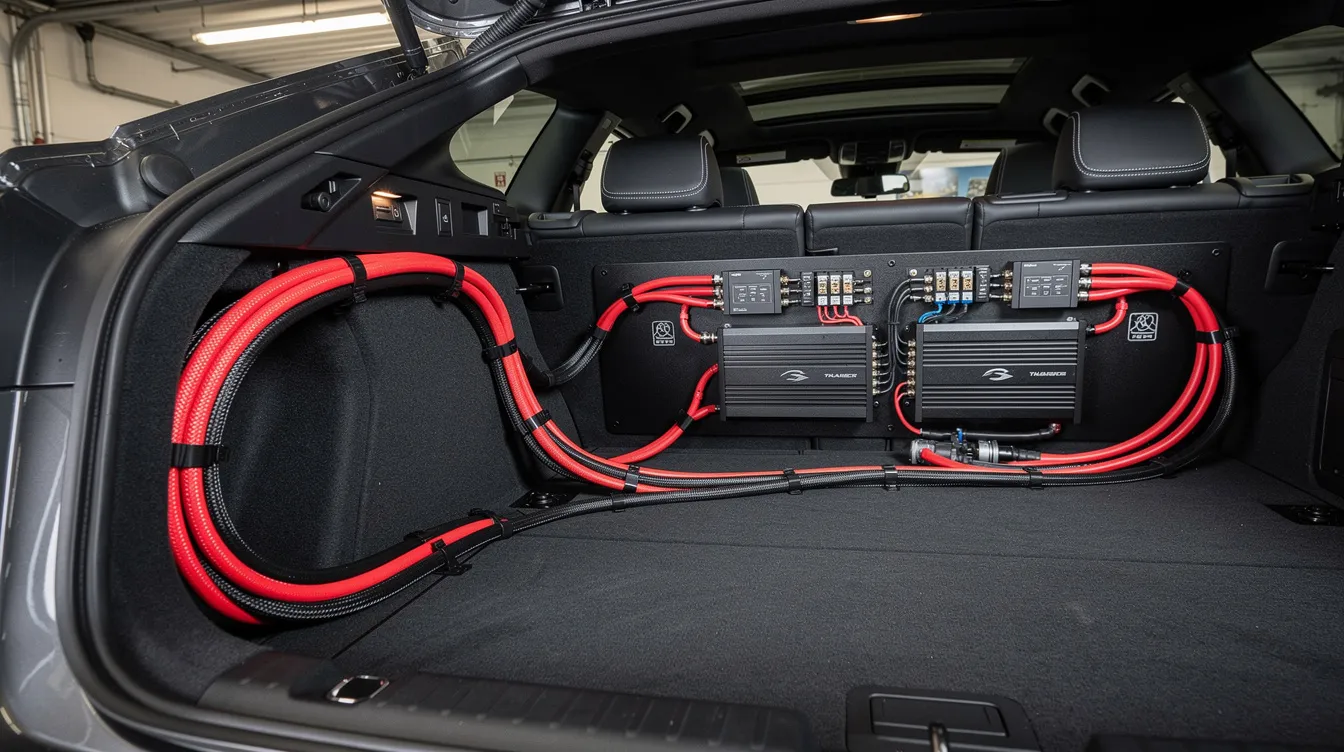
The Big 3 should use the same gauge as the main amplifier power wire - for example, 1/0 AWG copper for systems above ~1,500W RMS - to eliminate bottlenecks.
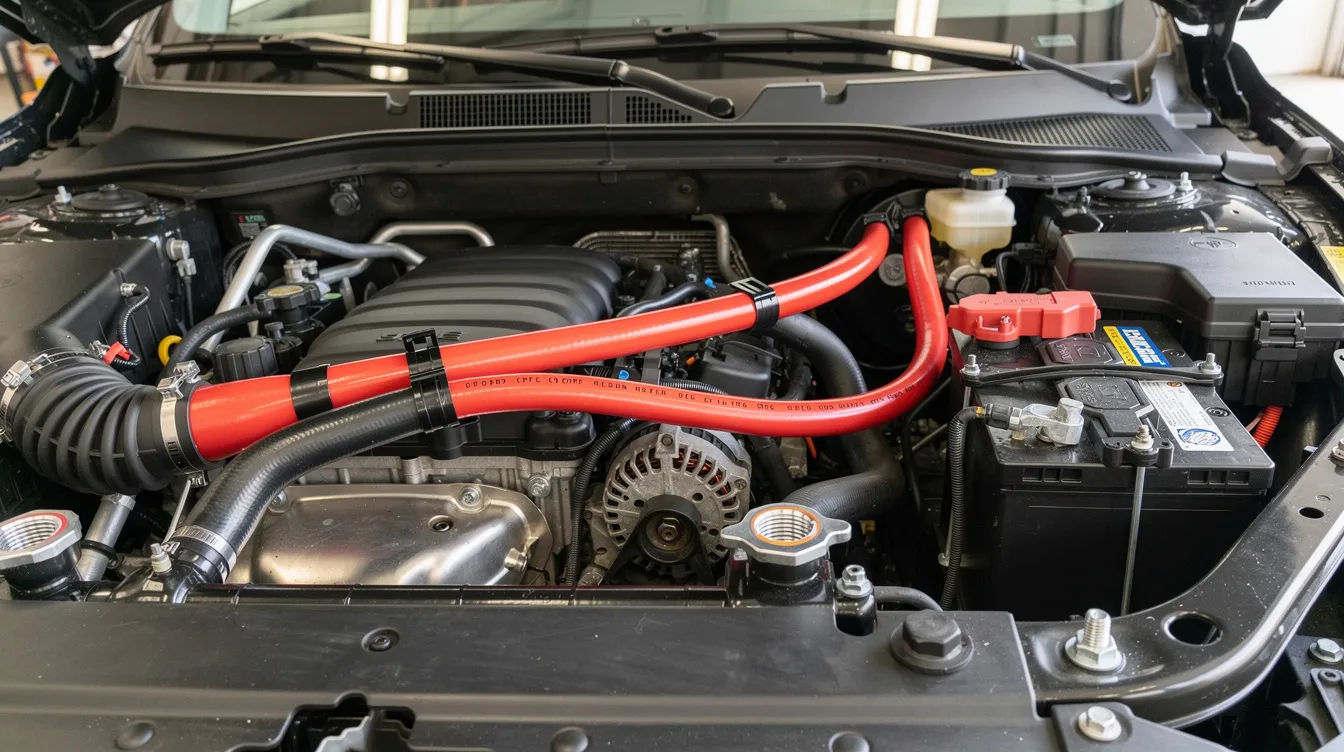
High-output alternators, AGM and lithium batteries, and stiffening banks should be wired with appropriately sized AWG conductors, often 1/0 or 2/0 copper for 250A+ charging systems. Even the best wire gauge chart will not fix an undersized alternator or weak battery, so system design must include electrical support. For step-by-step instructions, see our Big 3 Upgrade guide and our High Output Alternator Guide.
AWG Wire Chart Use Cases Beyond Car Audio
Non-Car Audio Applications
The same AWG wire gauge charts apply to other low-voltage DC systems. A qualified electrician uses identical principles when sizing chassis wiring for auxiliary lighting, winches, RV power, and overland rigs. In household applications:
-
14 AWG wire is typically used for 15-amp circuits - common applications for 14 AWG include 15-amp lighting and outlet circuits.
-
12 AWG wire is commonly used for 20-amp circuits like kitchen or laundry outlets.
-
10 AWG is used for 30-amp applications such as water heaters or HVAC units.
-
10 AWG wire can handle heavier loads than 14 AWG wire because of its larger cross-sectional area measured in circular mils.
For automotive use, you might run 4 AWG to a rear distribution block for air compressors and inverters, or size 8–10 AWG for long LED light bar runs to minimize voltage drop. Multi-purpose vehicles combining audio, off-road accessories, and inverters should size cabling based on combined current draw. Amped Up Car Audio can advise on these hybrid builds - the principles of calculating ampacity, voltage, and run length are universal for 12V systems.
Conclusion: Best Practices for Using a Wire Gauge Chart in Car Audio
To determine the correct wire size: calculate total RMS wattage and current draw, measure the longest run length, consult an AWG gauge chart for copper wire, then upsize if conditions are hot, bundled, or competition-level. AWG wire sizes are crucial for preventing overheating in circuits, and getting this right is foundational to every reliable car audio installation.
Essential rules to follow:
-
Always match power and ground wire size
-
Protect each run with a correctly sized fuse or breaker
-
Account for ambient temperature and bundling when calculating derating
-
Prioritize OFC copper for main power and speaker wiring
-
Inspect connections regularly - wire gauge charts are starting points, and real-world tuning comes from experience, inspection, and voltage monitoring at the amplifier under load
Contact Amped Up Car Audio for personalized wire sizing recommendations, complete wiring kits, and expert installation guidance based on thousands of real builds and over two decades of SPL competition.
FAQ: Wire Gauge Charts & Car Audio Wiring
What gauge wire should I use for a 1000 watt amp?
-
For a typical 1,000W RMS Class D amplifier on 12–14V in a passenger car, 4 AWG copper power and ground wire is generally appropriate for runs up to about 15–16 ft.
-
For longer runs (SUVs or trucks with 18–20 ft cable), or if using a less efficient Class AB amp, stepping up to 1/0 AWG copper controls voltage drop more effectively.
-
The main fuse near the battery will usually fall in the 120–150A range for this setup. If the 1,000W rating is peak rather than true RMS, actual current may be lower - but sizing based on the higher value builds in headroom for upgrades.
Can I mix different gauge wires in my car audio system?
-
Power and ground wires feeding the same amplifier should always be the same gauge to keep resistance balanced on both sides of the circuit.
-
It is acceptable to use smaller gauge wire for branch circuits from a large main trunk line, as long as each branch is correctly fused for its wire size.
-
Never neck down a large gauge main feed to a smaller gauge at the amplifier input without adjusting fuse size - this turns the smaller wire into a fuse link and potential fire hazard.
-
Plan the entire system layout so that gauge transitions, distribution blocks, and fusing all align with the specifications from your wire gauge chart.
Is it bad to oversize my wire gauge?
-
Electrically, oversizing wire is not harmful and is often beneficial - it means lower voltage drop and more headroom for future upgrades.
-
Trade-offs include higher weight, greater cost, and difficulty routing through tight factory grommets, especially with 1/0 AWG and 2/0 AWG cable measured in larger millimeters of diameter.
-
For daily-driver builds in the 500–1,500W RMS range, stepping one size larger than minimum (e.g., using 4 AWG instead of 8 AWG) is a smart long-term choice.
How does AWG apply if I'm running 16V or 18V competition systems?
-
Running 16V or 18V charging systems changes the calculation: higher voltage means lower current for the same RMS power, reducing the load on your wiring.
-
However, the wire's insulation and terminations still need to handle the higher voltage and heat in extreme SPL environments.
-
Builders of high-voltage competition systems should still use the same or larger AWG sizes suggested for 12–14V systems, using the lower current to reduce voltage drop even further.
-
These edge cases should be discussed directly with experienced competitors or Amped Up Car Audio's team, as safety margins are tighter.
How often should I inspect my wiring in a high-power car audio system?
-
Visually inspect all main power and ground connections at least every 6–12 months in daily drivers above ~1,500W RMS, and more often in competition vehicles.
-
Watch for discolored insulation, melted fuse holders, loose set-screws in distribution blocks, green or white corrosion on copper, and any sign of arcing or burning.
-
Periodically check voltage at the amplifier under load with a multimeter to confirm that connections and wire are still performing. Even correctly sized wire from the gauge chart can become unsafe if connections loosen due to vibration and heat cycling.
Call to Action: Get the Right Wire, the First Time
Use the charts and principles in this article to rough in your wire gauge needs, then reach out to Amped Up Car Audio for final confirmation before you purchase. We stock high-quality OFC copper power wire, speaker wire, fuse holders, distribution blocks, and complete Wiring Kits sized for systems from a few hundred watts to well over 8,000W RMS.
When you buy from a real shop with a physical location in Conover, NC and decades of competition-proven electrical experience, you're not guessing with off-brand kits - you're building with confidence. Contact us by phone, email, or live chat with your amp models, estimated RMS wattage, and vehicle type for a custom wire gauge recommendation. Browse our full line of wiring products and installation accessories today for safer installs and harder-hitting systems.
About the Author - Jacob Morris
Jacob Morris is the co-owner of Amped Up Car Audio and has spent 23 years immersed in car audio at every level - from street builds and custom installs to SPL competition and founding his own car audio wire and accessories company. With hands-on experience spanning electrical systems, high-output alternators, AGM and lithium batteries, and system design at every power level, Jacob brings real-world knowledge that goes well beyond the spec sheet. His wire company background makes him uniquely qualified to cut through the OFC vs CCA confusion. He has built and tuned hundreds of systems, competed at the national level, and contributed to one of the loudest car audio builds ever recorded at 181.32 dB.
When Jacob writes about car audio, it comes from 23 years of actually doing it.