
Why Is My Amp Overheating So Quickly? Common Causes and Solutions
Posted by Jacob Morris on Jun 4th 2026
Why Is My Amp Overheating So Quickly? (Car Audio Troubleshooting Guide)
If you are asking, “why is my amp overheating so quickly,” your car audio system is probably cutting out, going into protect, or getting hot enough to make you nervous. This guide is for car audio enthusiasts and vehicle owners who notice their amplifier overheating quickly. It covers the most common causes, troubleshooting steps, and solutions to keep your system running cool and reliable. A warm amplifier can be normal, but fast overheating usually points to a problem with airflow, wiring, gain, speaker load, or the amp itself.
Quick Answers: Top Reasons Your Car Amp Gets Hot Fast
If your car audio amp runs hot or your amp gets hot when playing music, start with the basics before buying a new amp.
-
The gain setting is too high. High gain settings can cause amplifiers to overheat because pushing the gain or volume too high can distort the signal in amplifiers.
-
The speaker load is wrong. Verify speaker load configurations match the impedance rating of the amplifier, and verify that speaker wiring matches the stable ohm rating of an amplifier.
-
The amp has poor ventilation. Poor ventilation can cause amplifiers to overheat quickly, especially under seats, behind panels, or in tight boxes.
-
The power and ground wiring are too small or incorrect. Using thin power cables creates electrical resistance and heat in amplifiers.
-
The electrical system is weak. Low voltage from an old battery or weak alternator can make the amp clip, create more heat, and shut down.
-
The speakers or sub may be damaged. Blown speakers can cause amplifiers to overheat, and blown speakers can lead to amplifier overheating.
-
The amplifier may be failing internally.
What to check first: feel the chassis after 10–15 minutes of music playing, look for the protect light, and verify fan operation if your model has a fan. Most issues can be fixed with basic troubleshooting or help from Amped Up Car Audio.
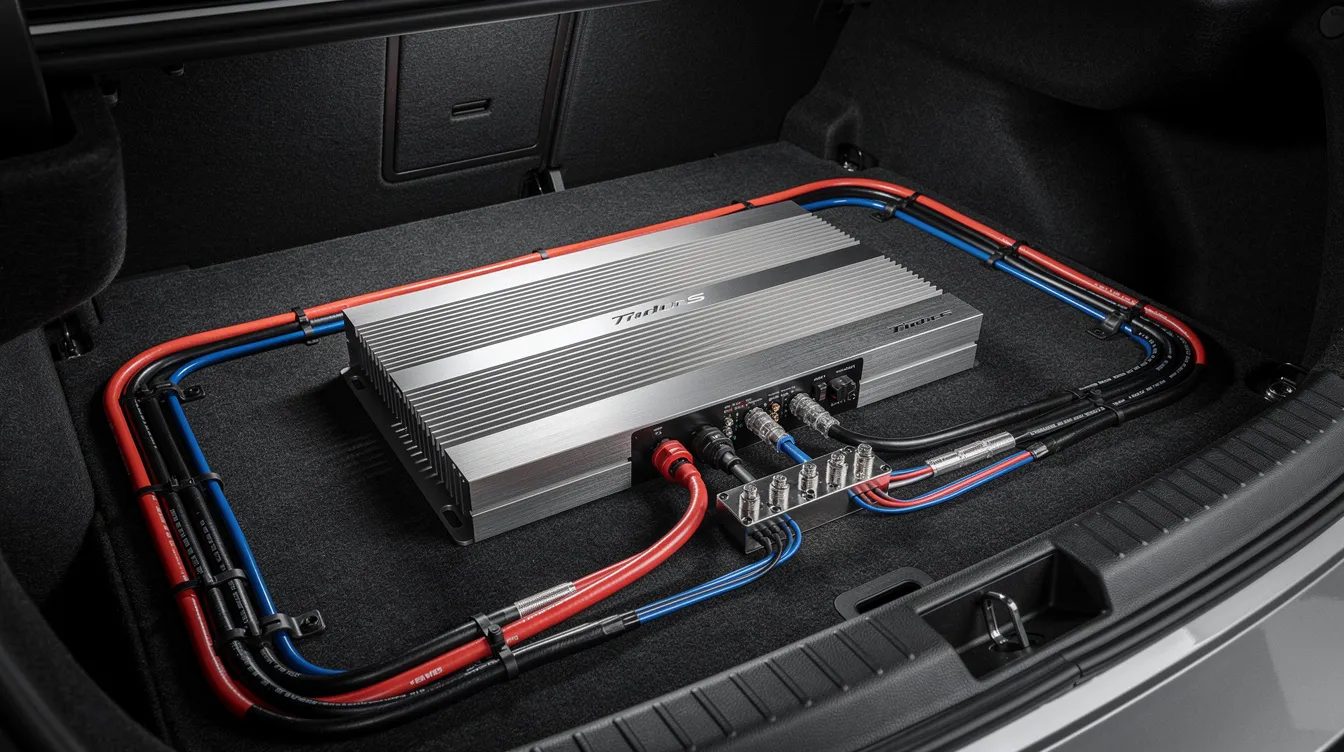
How Hot Is Too Hot? Normal Amp Temps vs Overheating
Car audio amplifiers will run warm. The difference is whether the heat sink can release heat faster than the circuit creates it.
-
Warm to the touch, roughly 90–120°F, is normal and usually fine.
-
Too hot to keep your hand on, often 150°F or higher, is a concern. An amplifier may overheat when it generates more internal heat than its heatsink can dissipate.
-
True overheating signs include thermal protection, sound cutting out after 10–20 minutes, distortion before shutdown, or a burnt smell.
-
Amplifiers can shut off to prevent permanent damage. That protect mode is a warning, not an inconvenience to ignore.
-
Class D amps are usually more efficient than Class AB amps. Low-efficiency amplifiers waste power as heat, and Class AB bias can make them run hot even at moderate volume.
-
Use a cheap infrared thermometer or temp probe to test the case temperature instead of guessing by ear or hand.
-
Repeated thermal protection events shorten amp and sub life, so do not keep trying to play loud if it keeps shutting down.
For a deeper technical comparison, efficiency differences between amplifier classes explain why the same power level can create very different heat.
Common Installation Mistakes That Make Your Amp Run Hot
Poor installation of amplifiers can lead to overheating, and in modern daily car audio installation jobs, airflow is often the biggest issue.
-
Poor ventilation: an amp stuffed under a rear seat, behind trunk trim, or inside a sealed enclosure has no airflow. Trapping an amplifier in a tight enclosure restricts airflow and causes overheating.
-
Mounting to carpet or insulation traps heat and blocks the heat sink fins. Mount the amp to MDF, plastic board, or metal instead.
-
Stacking amps together, mounting upside down, or blocking the top of the chassis traps hot air.
-
Leave several inches of open space around the amplifier chassis for proper clearance; 2–3 inches is a good target.
-
Avoid direct sun on rear parcel shelves, and avoid installing amplifiers near heat sources increases the risk of overheating.
-
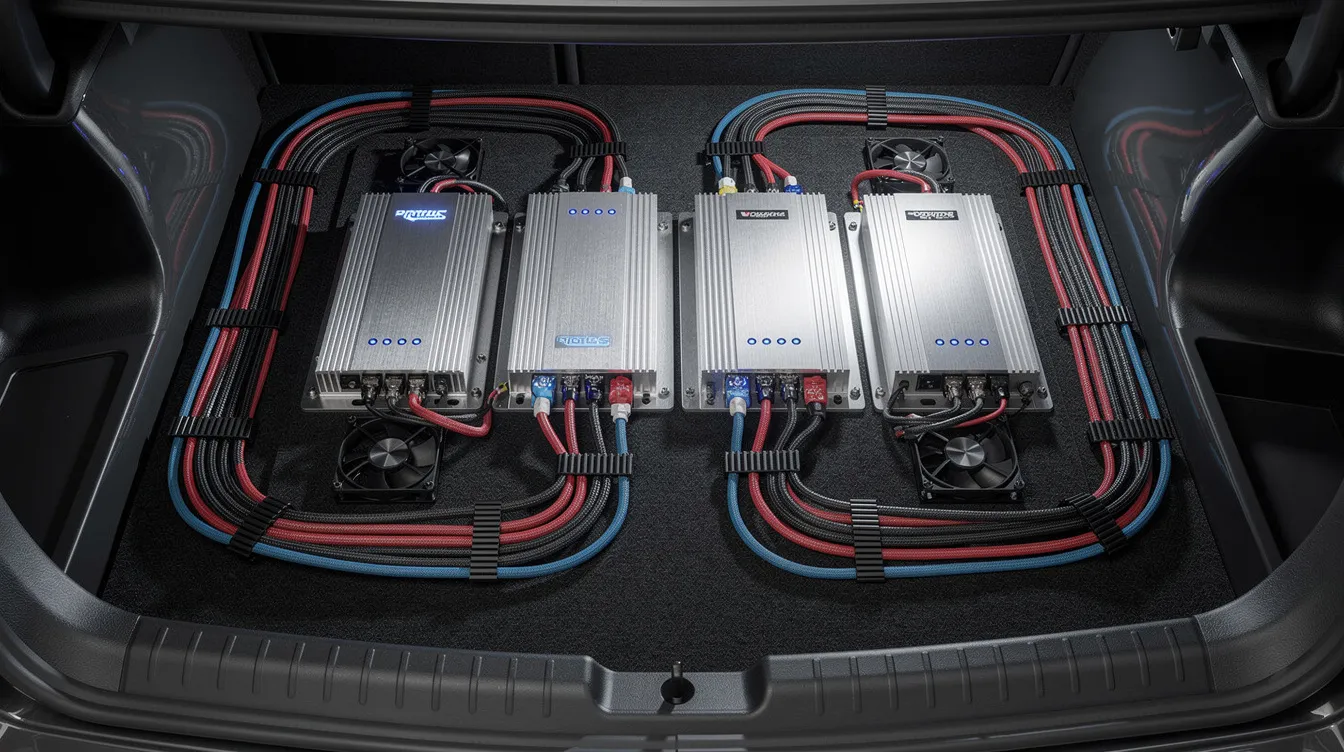
Installing external cooling fans can help in enclosed setups to prevent overheating, especially in trucks or false-floor builds.
-
Regularly clean amplifiers to prevent heat insulation from dust.
-
A vented amp rack and a small 12V fan can help your amp run cool while playing music loudly.
Electrical & Wiring Issues That Make an Amp Overheat
The amp’s power and ground system decides how hard the amplifier has to work. Electrical strain on amplifiers can result in overheating.
-
Undersized power wire is a common cause. Running a 1500W RMS amp on 8-gauge wire instead of recommended 4-gauge or 0-gauge increases resistance, voltage drop, current draw, and heat.
-
Use the correct gauge for power and ground wires. Using incorrect wire gauge can lead to overheating, so use the correct wire gauge for your amplifier.
-
Incorrect power wiring can lead to overheating in amplifiers, especially with loose fuse holders, poor terminals, or cheap aluminum cable.
-
A bad ground causes voltage drop and instability. Grind the ground location to bare metal, use a short thick ground, and connect it securely to the vehicle frame or chassis.
-
Clean connections prevent overheating in amplifiers, and clean amplifier connections to improve performance.
-
A weak charging system can drop below healthy voltage when the bass hits. Test voltage at idle and while driving; most systems should stay around 13.5–14.4V.
-
The Big 3 Upgrade improves electrical connections by upgrading alternator positive, battery ground, and engine/frame ground paths.
-
Poor speaker wiring matters too. Frayed speaker wires, shorts to the car body, or the wrong series/parallel layout can create a dangerous load.
For wire sizing, use an amp wiring kit matched to RMS power and cable length. Amped Up Car Audio stocks quality wiring, batteries, and upgrade parts built for real high-power systems.
Gain, Ohms & Tuning: Are You Pushing Your Amp Too Hard?
Many “my amp overheats fast” problems trace back to tuning and load, not a bad amplifier.
Gain is a control on your amplifier that adjusts the input sensitivity to match the output of your head unit or radio.
-
Gain is not a volume knob. It matches the amp input to the head unit or radio output. Too much gain causes clipping, distortion, and more heat.
-
Set the gain correctly to prevent overheating. Use a multimeter to set the gain below the clipping threshold, or use an oscilloscope or distortion detector if available.
Impedance, measured in ohms, is the resistance a speaker presents to the amplifier. Matching the speaker load impedance to the amplifier's rating is crucial for safe operation.
-
Running speakers with lower ohms than the amplifier rating can force excess current draw. For example, wiring a sub to 1 ohm on an amp rated 2 ohms stable is wrong and can get hot quickly.
-
Lower impedance means more power demand, more current, and more heat. That difference can push the amp into protect fast.
-
Check the amp manual for minimum load per channel, bridged ratings, and common dual 2-ohm or dual 4-ohm wiring examples.
-
Do not crank bass boost, loudness, or EQ at the head unit just because it sounds good at first. Overdriving an audio system generates excessive heat in amplifiers.
-
Set crossovers correctly so the amp is not trying to play frequencies the speakers cannot handle.
If forum advice says “just max the gain, lol,” ignore it. Tuning by ear alone is not enough; absolutely use a meter or a real gain guide.
Type of Amp & System Design: When Power and Use Don’t Match
Daily driving systems and demo builds do not have the same cooling needs.
-
A small 500W budget amp pushed at full tilt to keep up with two big subwoofers will run hot faster than a correctly sized 1000–1500W amp cruising at half output.
-
More power is not always abuse. The right amp can have headroom, balance, and control.
-
If your system needs a lot more power than the amp can provide, expect clipping, heat, and shutdown.
-
Class AB full-range amps usually make more heat than efficient Class D monoblocks at similar output.
-
Playing music is different from test tones. Long 30–40 Hz bass tracks can hold an amplifier near full output in a way normal music does not.
-
Be realistic about your use: daily listening, car meets, demos, or burps all stress the system differently.
-
If the amp is always at max gain and volume just to hear it, the system is underpowered.
Signs Your Amp Is Actually Failing (Not Just Mis-Installed)
Most overheating issues are fixable, but some signs point to internal damage.
-
The amp overheats even at low volume with proper airflow, correct wiring, and correct load.
-
One channel runs much hotter than the others, or one channel has distortion before the rest.
-
The internal fan does not spin, grinds, or only starts after the amp is already hot.
-
You see burn marks, melted terminals, or smell burnt electronics.
-
The amp gets hot as hell immediately after turn-on with no music.
-
After repeated shut downs, internal components may already be damaged.
At that point, do not keep forcing it to play. A failed power supply, shorted output device, or damaged protection circuit can become a fire risk.
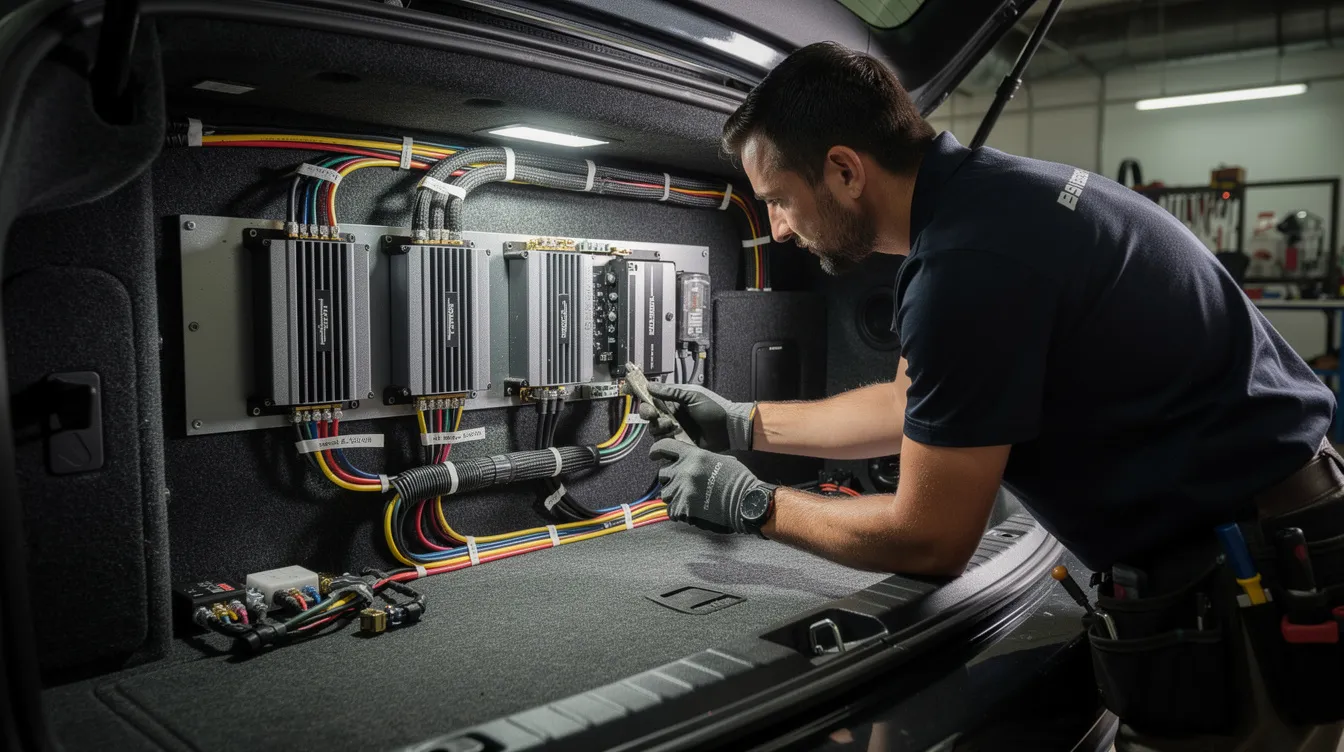
Step-by-Step: How to Troubleshoot an Overheating Car Audio Amp
Use this driveway troubleshooting checklist before replacing gear.
-
Step 1: Inspect the install. Check location, airflow, stacked gear, carpet mounting, and how hot the amp gets after 10–15 minutes at normal volume.
-
Step 2: Check all power and ground connections for tightness, corrosion, and cable size. As a rough guide, many 600–1000W systems need 4-gauge, while higher power may need 0-gauge.
-
Step 3: Use a multimeter to verify subwoofer or speaker impedance at the amp terminals. Confirm you are not below the rated ohm load.
-
Step 4: Back down gain, bass boost, and EQ. Retest and listen for clean audio instead of distortion.
-
Step 5: Test charging voltage at idle and with music playing. If voltage falls hard, inspect the battery, alternator, grounds, and Big 3 wiring.
-
Step 6: Disconnect speakers one at a time to check for blown drivers or shorted wires.
-
Step 7: If the amp still overheats quickly after checking the issues mentioned earlier in this list, contact a specialist like Amped Up Car Audio for deeper troubleshooting and more info.
Why Choose Amped Up Car Audio to Help Fix Your Overheating Amp?
Amped Up Car Audio is an online retailer with real expert experience. That matters because overheating is rarely one isolated issue; it is usually wiring, load, tuning, and install location working against each other.
-
Our team designs and installs high-power systems with subwoofers, monoblock amps, multi-channel amps, batteries, wiring, speakers, and accessories.
-
We see overheating issues in real customer cars every week, not just on spec sheets.
-
Customers can call, email, or visit the shop with photos of the amp, wiring, ground, battery, and sub setup.
-
We help identify concrete fixes: better wire, corrected impedance, cleaner ground, cooling, retuning, or a better matched amplifier.
-
We stock properly sized amp kits, AGM batteries, Big 3 components, cooling fans, and matched amplifiers.
-
Online customers can use our experience before buying the wrong part twice.
Choosing the Right Amp, Wiring & Cooling to Keep Your System Running Cool
Once the current issue is solved, build the system so it stays cool.
-
Choose an amp with RMS power that comfortably matches or slightly exceeds the total RMS of your speakers or subwoofers.
-
Use high-quality OFC wiring in the correct gauge for power and run length.
-
Add Big 3 upgrades and secondary batteries for serious systems, especially around 1500W+.
-
Plan the amp location before the install: trunk racks, vented false floors, or under-seat mounts with fans.
-
Proper airflow is crucial for amplifier installation, and ensure proper airflow around your amplifier during installation.
-
Proper tuning is as important as hardware. Gain, crossovers, bass boost, and head unit volume all affect heat.
-
Browse Amped Up Car Audio for amplifiers, subwoofers, wiring kits, batteries, and cooling accessories built for reliable sound.
Explore More Amplifier Troubleshooting Guides
For deeper insights and solutions to common amplifier problems, check out these helpful guides on our site:
-
Understanding What Is Gain on an Amp: Essential Insights for Users — Learn how gain settings affect your amplifier’s performance and how to set it correctly to avoid overheating and distortion.
-
Troubleshooting: Car Amp Turns On but No Sound Issues Explained — Discover common causes and fixes when your amplifier powers up but produces no sound.
-
Understanding Alternator Whine: Causes and Solutions for Your Vehicle — Identify why alternator whine occurs and how to eliminate this annoying noise from your car audio system.
-
Troubleshooting a Car Amp Not Working: Common Issues and Solutions — Step-by-step guidance to diagnose and resolve why your amplifier may fail to operate.
-
How to Bypass Protection Mode on Amp: Effective Tips and Techniques — Find out how to safely address protection mode triggers and get your amp running smoothly again.
These resources complement this guide and provide expert advice to keep your car audio system running cool, clear, and powerful.
FAQs: Car Audio Amps That Run Hot
Why does my amp get hot and shut off after 10–15 minutes of playing music?
The amp is likely entering thermal protection because it is making more heat than it can release. Common causes include poor airflow, high gain, clipping, bad ground, low impedance wiring, or damaged speakers.
Is it normal for a car audio amp to be too hot to touch?
Warm is normal. Too hot to hold your hand on is not. If the amp is around 150°F or more, smells burnt, or keeps going into protect, stop using it and test the system.
Can bad ground cause my amp to overheat?
Yes. A bad ground creates voltage drop, instability, and extra electrical strain inside the amplifier. Clean bare metal, tight hardware, and short ground cable make a major difference.
Will a cooling fan really help keep my amp cool?
Yes, a fan can help in tight spaces or high-power builds. But if the amp is wired below its stable load, clipping badly, or running on weak power, a fan only masks the real problem.
Can I run my amp at 1 ohm if it’s only rated for 2 ohms?
No. A 2-ohm stable amp is not designed for a 1-ohm load. That lower load forces excess current draw, more heat, protect mode, and possible failure.
How do I know if my amp is too small for my subs?
If the amp is always maxed out, clips often, overheats at modest volume, or never sounds loud and clean, it may be too small. Amped Up Car Audio can help match the right amp to your exact sub impedance and RMS rating.
Should I replace my overheating amp or can it be repaired?
If the issue is airflow, gain, wiring, or load, you may only need a retune or rewire. If the amp overheats with no load, smells burnt, has melted terminals, or one channel fails, professional diagnosis or a modern efficient replacement may be the better value.
If your amp is getting hot, do not guess. Fix the cause, protect your gear, and reach out to Amped Up Car Audio for parts, troubleshooting, or online help.